If a number is decreased by 3, the principal square root of this difference is 5 less than the number. Find the number(s).
Ch. 1 - Equations and Inequalities

Chapter 2, Problem 109
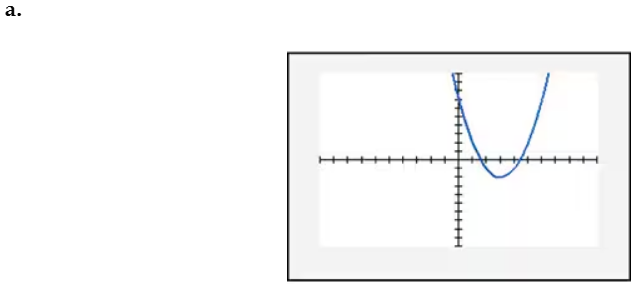
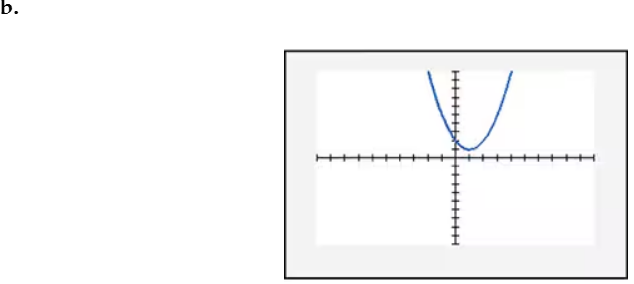
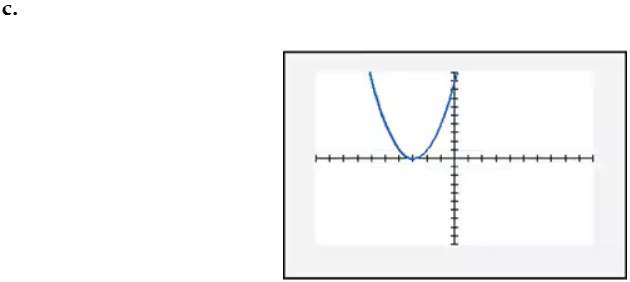
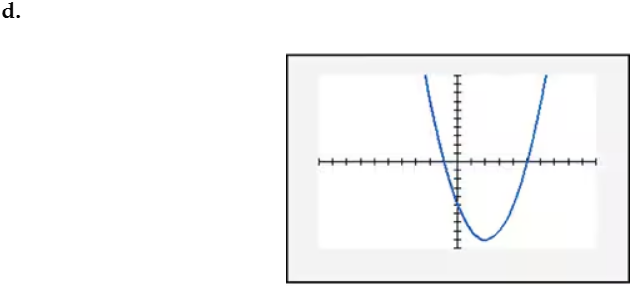
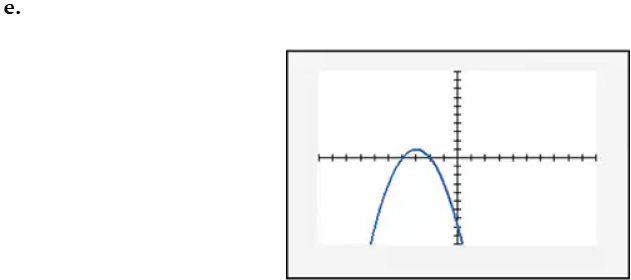
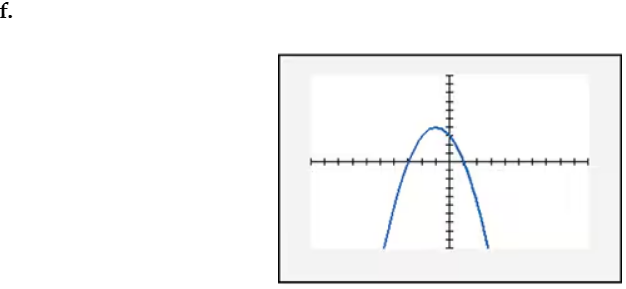
In Exercises 109–114, find the x-intercept(s) of the graph of each equation. Use the x-intercepts to match the equation with its graph. The graphs are shown in [- 10, 10, 1] by [- 10, 10, 1] viewing rectangles and labeled (a) through (f). y = x2 - 4x - 5


Verified step by step guidance1
To find the x-intercepts of the graph of the equation y = x^2 - 4x - 5, set y = 0 because the x-intercepts occur where the graph crosses the x-axis (i.e., where y = 0). This gives the equation 0 = x^2 - 4x - 5.
Rewrite the equation as x^2 - 4x - 5 = 0. This is a quadratic equation, and we will solve it using factoring, the quadratic formula, or completing the square. In this case, factoring is a good approach.
Factor the quadratic equation x^2 - 4x - 5. Look for two numbers that multiply to -5 (the constant term) and add to -4 (the coefficient of x). These numbers are -5 and 1, so the equation factors as (x - 5)(x + 1) = 0.
Apply the Zero Product Property, which states that if a product of two factors equals zero, then at least one of the factors must be zero. Set each factor equal to zero: x - 5 = 0 and x + 1 = 0.
Solve each equation for x. For x - 5 = 0, add 5 to both sides to get x = 5. For x + 1 = 0, subtract 1 from both sides to get x = -1. Therefore, the x-intercepts are x = 5 and x = -1.

Verified video answer for a similar problem:
This video solution was recommended by our tutors as helpful for the problem above.
Video duration:
1mWas this helpful?
Key Concepts
Here are the essential concepts you must grasp in order to answer the question correctly.
X-Intercept
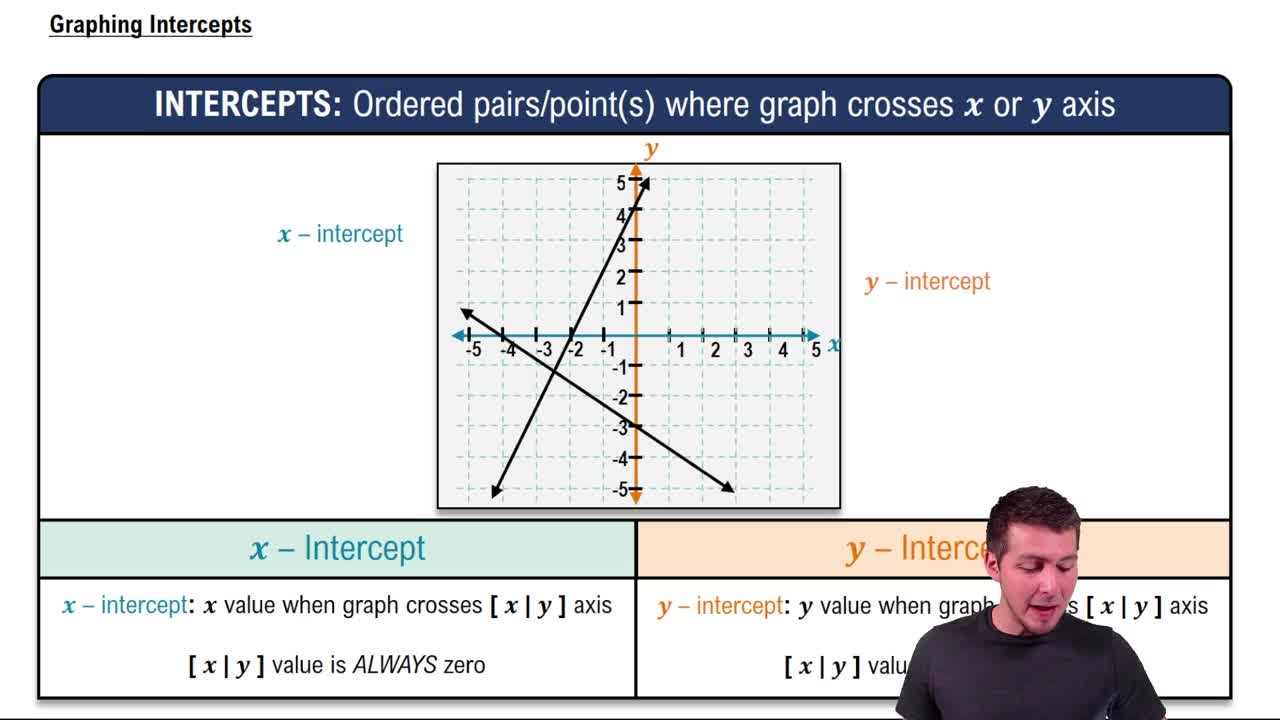
The x-intercept of a graph is the point where the graph intersects the x-axis. This occurs when the value of y is zero. To find the x-intercept(s) of an equation, you set y equal to zero and solve for x. In the context of the given equation, this means solving the quadratic equation x^2 - 4x - 5 = 0.
Recommended video:
Guided course
Graphing Intercepts
Quadratic Equations
A quadratic equation is a polynomial equation of the form ax^2 + bx + c = 0, where a, b, and c are constants, and a is not zero. The solutions to a quadratic equation can be found using factoring, completing the square, or the quadratic formula. Understanding how to manipulate and solve these equations is essential for finding x-intercepts.
Recommended video:
Introduction to Quadratic Equations
Graphing Quadratics
Graphing a quadratic function involves plotting a parabolic curve that opens upwards or downwards, depending on the sign of the leading coefficient (a). The vertex of the parabola represents the maximum or minimum point, while the x-intercepts indicate where the graph crosses the x-axis. Recognizing the shape and key features of quadratic graphs is crucial for matching equations to their corresponding graphs.
Recommended video:
Solving Quadratic Equations Using The Quadratic Formula
Related Practice
Textbook Question
728
views
Textbook Question
Solve each equation in Exercises 83–108 by the method of your choice. 3/(x - 3) + 5/(x - 4) = (x2 - 20)/(x2 - 7x + 12)
954
views
Textbook Question
Solve and graph the solution set on a number line: (2x−3)/4 ≥ 3x/4 + 1/2
737
views
Textbook Question
When 4 times a number is subtracted from 5, the absolute value of the difference is at most 13. Use interval notation to express the set of all numbers that satisfy this condition.
858
views
Textbook Question
In Exercises 109–114, find the x-intercept(s) of the graph of each equation. Use the x-intercepts to match the equation with its graph. The graphs are shown in [- 10, 10, 1] by [- 10, 10, 1] viewing rectangles and labeled (a) through (f). y = - (x + 1)2 + 4
923
views
Textbook Question
In Exercises 107–110, use graphs to find each set. [1,3) ∩ (0,4)
509
views