Solve each equation. Then state whether the equation is an identity, a conditional equation, or an inconsistent equation. (3x+1)/3 - 13/2 = (1-x)/4
Ch. 1 - Equations and Inequalities

Chapter 2, Problem 27
In Exercises 21–28, divide and express the result in standard form. (2 + 3i)/(2 + i)
Verified step by step guidance1
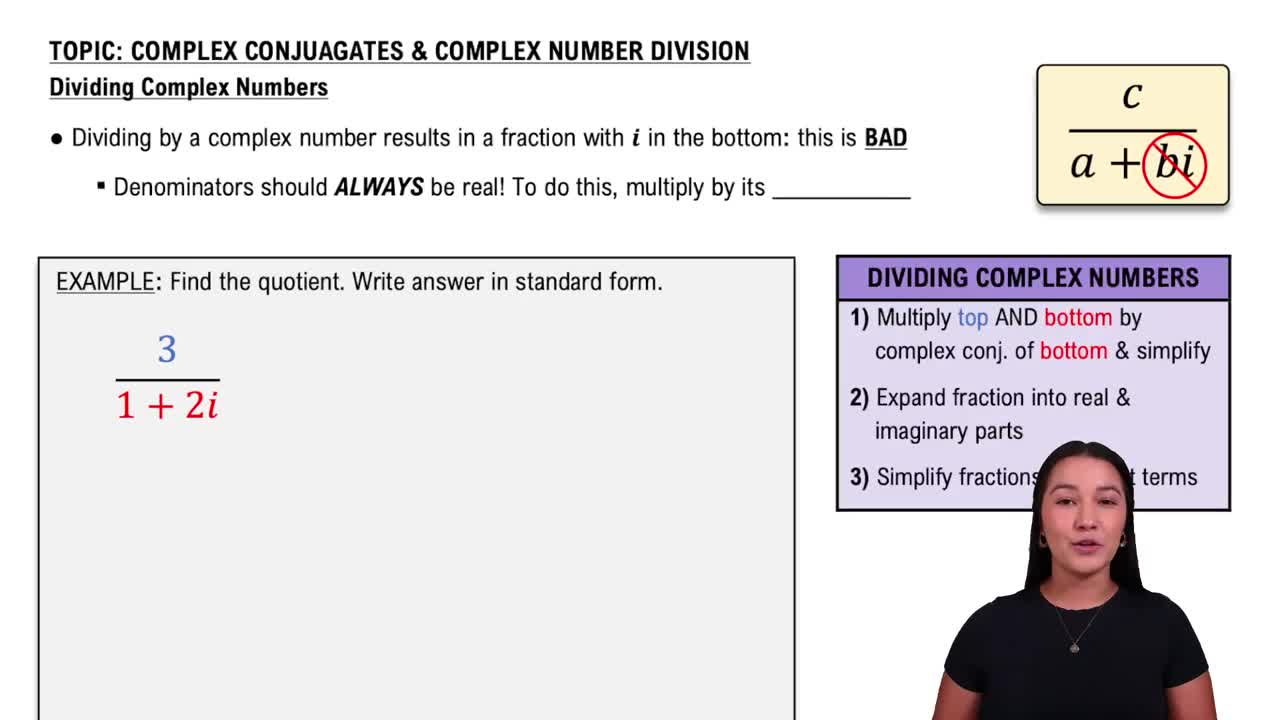
Identify the problem: You are dividing two complex numbers, \( \frac{2 + 3i}{2 + i} \). To simplify, we need to eliminate the imaginary part from the denominator by multiplying both numerator and denominator by the conjugate of the denominator.
Find the conjugate of the denominator \( 2 + i \). The conjugate is \( 2 - i \). Multiply both numerator and denominator by \( 2 - i \): \( \frac{(2 + 3i)(2 - i)}{(2 + i)(2 - i)} \).
Simplify the denominator using the difference of squares formula: \( (2 + i)(2 - i) = 2^2 - i^2 = 4 - (-1) = 5 \). The denominator becomes 5.
Expand the numerator using the distributive property: \( (2 + 3i)(2 - i) = 2(2) + 2(-i) + 3i(2) + 3i(-i) = 4 - 2i + 6i - 3i^2 \). Simplify the terms: \( 4 + 4i - 3(-1) = 4 + 4i + 3 = 7 + 4i \).
Combine the results: The simplified expression is \( \frac{7 + 4i}{5} \). To express in standard form, divide each term in the numerator by the denominator: \( \frac{7}{5} + \frac{4}{5}i \).

Verified video answer for a similar problem:
This video solution was recommended by our tutors as helpful for the problem above.
Video duration:
4mWas this helpful?
Key Concepts
Here are the essential concepts you must grasp in order to answer the question correctly.
Complex Numbers
Complex numbers are numbers that have a real part and an imaginary part, expressed in the form a + bi, where a is the real part and b is the coefficient of the imaginary unit i (where i² = -1). Understanding complex numbers is essential for performing operations such as addition, subtraction, multiplication, and division.
Recommended video:
Dividing Complex Numbers
Division of Complex Numbers
Dividing complex numbers involves multiplying the numerator and the denominator by the conjugate of the denominator. The conjugate of a complex number a + bi is a - bi. This process eliminates the imaginary part in the denominator, allowing the result to be expressed in standard form, which is a + bi.
Recommended video:
Dividing Complex Numbers
Standard Form of Complex Numbers
The standard form of a complex number is a + bi, where a and b are real numbers. In this form, a represents the real part and b represents the imaginary part. Expressing a complex number in standard form is crucial for clarity and further mathematical operations, making it easier to interpret and manipulate.
Recommended video:
Multiplying Complex Numbers
Related Practice
Textbook Question
1008
views
Textbook Question
The length of the rectangular tennis court at Wimbledon is 6 feet longer than twice the width. If the court's perimeter is 228 feet, what are the court's dimensions?
680
views
Textbook Question
Graph each equation in Exercises 13 - 28. Let x = - 3, - 2, - 1, 0, 1, 2, 3
y = x3
228
views
Textbook Question
In all exercises, other than exercises with no solution, use interval notation to express solution sets and graph each solution set on a number line. In Exercises 27–50, solve each linear inequality. 5x + 11 < 26
757
views
Textbook Question
Exercises 27–40 contain linear equations with constants in denominators. Solve each equation. x/3 = x/2 - 2
944
views
Textbook Question
Solve each equation in Exercises 15–34 by the square root property.
907
views