Solve each equation. Then state whether the equation is an identity, a conditional equation, or an inconsistent equation. (3x+1)/3 - 13/2 = (1-x)/4
Ch. 1 - Equations and Inequalities

Chapter 2, Problem 27
Solve each equation in Exercises 15–34 by the square root property.
Verified step by step guidance1
Recognize that the equation is in the form \( (x - a)^2 = k \), where \(a = 3\) and \(k = -5\). The square root property states that if \( (x - a)^2 = k \), then \( x - a = \pm \sqrt{k} \).
Apply the square root property to the equation: write \( x - 3 = \pm \sqrt{-5} \).
Since the square root of a negative number involves imaginary numbers, express \( \sqrt{-5} \) as \( \sqrt{5}i \), where \(i\) is the imaginary unit with the property \( i^2 = -1 \). So, rewrite the equation as \( x - 3 = \pm \sqrt{5}i \).
Isolate \(x\) by adding 3 to both sides: \( x = 3 \pm \sqrt{5}i \).
Write the final solution as two complex numbers: \( x = 3 + \sqrt{5}i \) and \( x = 3 - \sqrt{5}i \). These are the solutions to the equation using the square root property.

Verified video answer for a similar problem:
This video solution was recommended by our tutors as helpful for the problem above.
Video duration:
2mWas this helpful?
Key Concepts
Here are the essential concepts you must grasp in order to answer the question correctly.
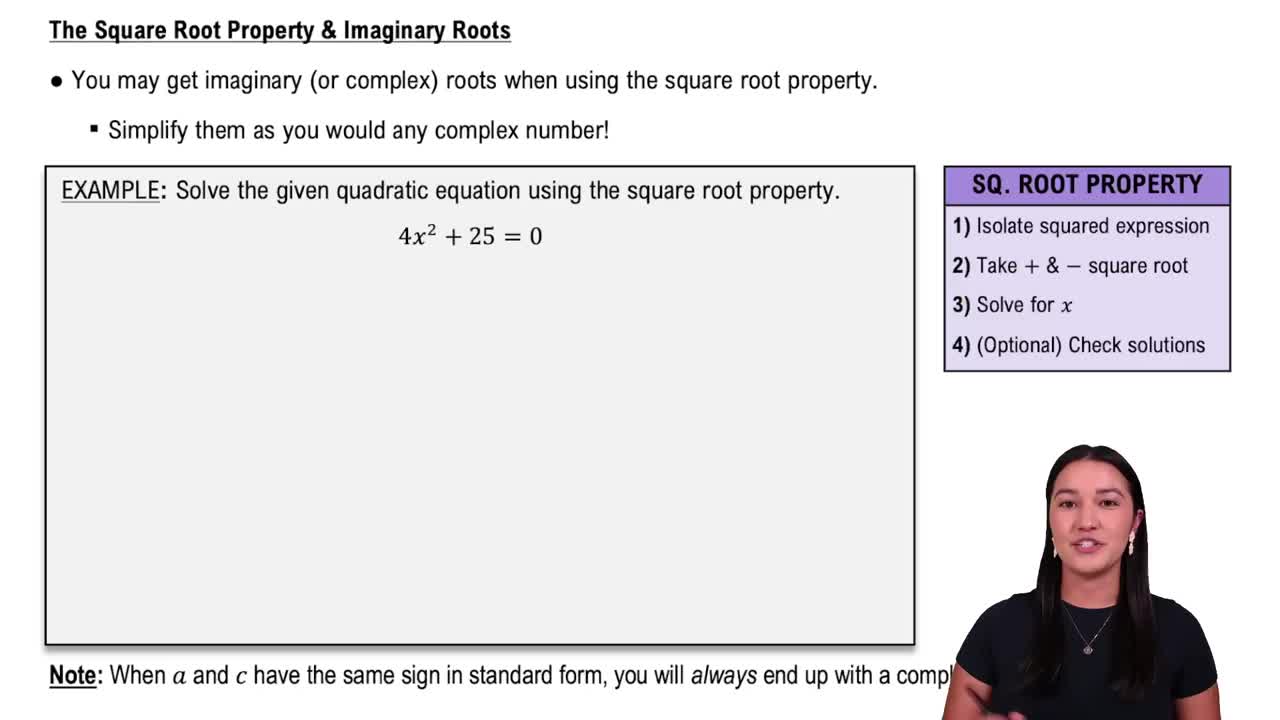
Square Root Property
The square root property states that if an equation is in the form (x - a)^2 = b, then x - a = ±√b. This allows solving quadratic equations by isolating the squared term and taking the square root of both sides, considering both positive and negative roots.
Recommended video:
Imaginary Roots with the Square Root Property
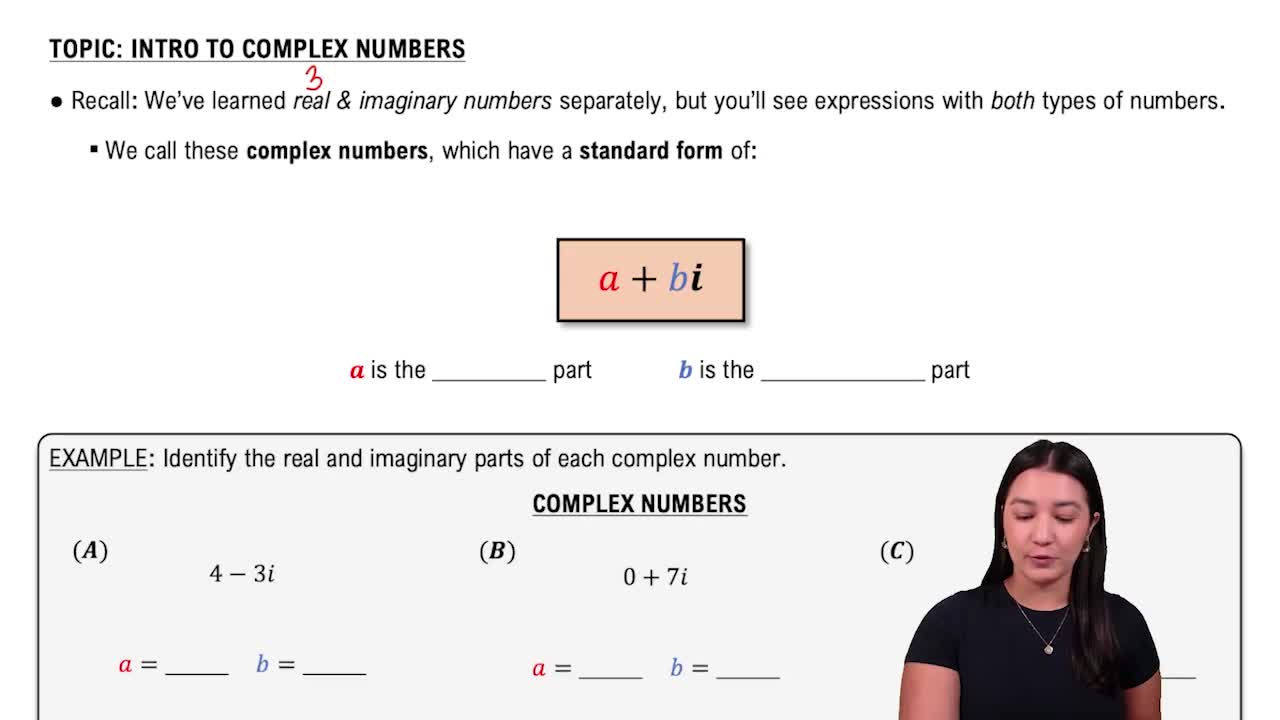
Complex Numbers and Imaginary Unit
When the equation involves the square root of a negative number, solutions are not real but complex. The imaginary unit i is defined as √(-1), enabling the expression of roots of negative numbers as multiples of i, such as √(-5) = i√5.
Recommended video:
Introduction to Complex Numbers
Isolating the Variable
Before applying the square root property, the equation must be manipulated to isolate the squared term on one side. This involves algebraic steps like adding or subtracting terms to simplify the equation to the form (x - a)^2 = b.
Recommended video:
Guided course
Equations with Two Variables
Related Practice
Textbook Question
1008
views
Textbook Question
In Exercises 21–28, divide and express the result in standard form. (2 + 3i)/(2 + i)
118
views
Textbook Question
The length of the rectangular tennis court at Wimbledon is 6 feet longer than twice the width. If the court's perimeter is 228 feet, what are the court's dimensions?
680
views
Textbook Question
In all exercises, other than exercises with no solution, use interval notation to express solution sets and graph each solution set on a number line. In Exercises 27–50, solve each linear inequality. 5x + 11 < 26
757
views
Textbook Question
Exercises 27–40 contain linear equations with constants in denominators. Solve each equation. x/3 = x/2 - 2
944
views
Textbook Question
Solve each radical equation in Exercises 11–30. Check all proposed solutions. √(2x + 3) + √(x - 2) = 2
787
views