Find the coordinates of the vertex for the parabola defined by the given quadratic function. f(x)=−2(x+1)2+5
Ch. 3 - Polynomial and Rational Functions

Chapter 4, Problem 10
In Exercises 9–16, a) List all possible rational zeros. b) Use synthetic division to test the possible rational zeros and find an actual zero. c) Use the quotient from part (b) to find the remaining zeros of the polynomial function. f(x)=x3−2x2−11x+12
Verified step by step guidance1
Identify the polynomial function: \(f(x) = x^{3} - 2x^{2} - 11x + 12\).
List all possible rational zeros using the Rational Root Theorem. These are all factors of the constant term (12) divided by factors of the leading coefficient (1). So, possible rational zeros are \(\pm 1, \pm 2, \pm 3, \pm 4, \pm 6, \pm 12\).
Use synthetic division to test each possible rational zero by substituting them into the polynomial. Start with one candidate, perform synthetic division, and check if the remainder is zero. If the remainder is zero, that candidate is an actual zero of the polynomial.
Once an actual zero is found, the quotient from the synthetic division will be a quadratic polynomial. Write down this quotient polynomial.
Solve the quadratic polynomial from the quotient using factoring, completing the square, or the quadratic formula to find the remaining zeros of the original polynomial.

Verified video answer for a similar problem:
This video solution was recommended by our tutors as helpful for the problem above.
Video duration:
5mWas this helpful?
Key Concepts
Here are the essential concepts you must grasp in order to answer the question correctly.
Rational Root Theorem
The Rational Root Theorem helps identify all possible rational zeros of a polynomial by considering factors of the constant term and the leading coefficient. These possible roots are expressed as ±(factors of constant term)/(factors of leading coefficient), providing a finite list to test.
Recommended video:
Guided course
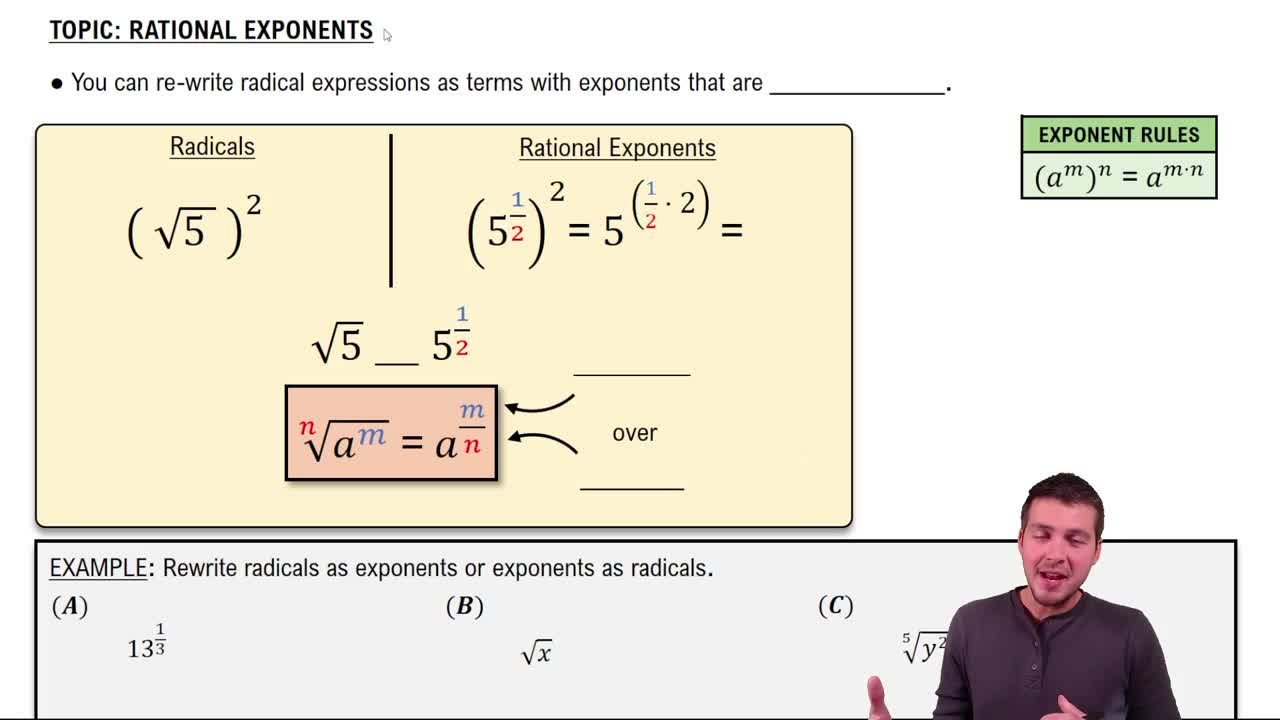
Rational Exponents
Synthetic Division
Synthetic division is a streamlined method for dividing a polynomial by a binomial of the form (x - c). It simplifies the process of evaluating whether a candidate root is an actual zero by checking if the remainder is zero, and it produces a quotient polynomial for further analysis.
Recommended video:
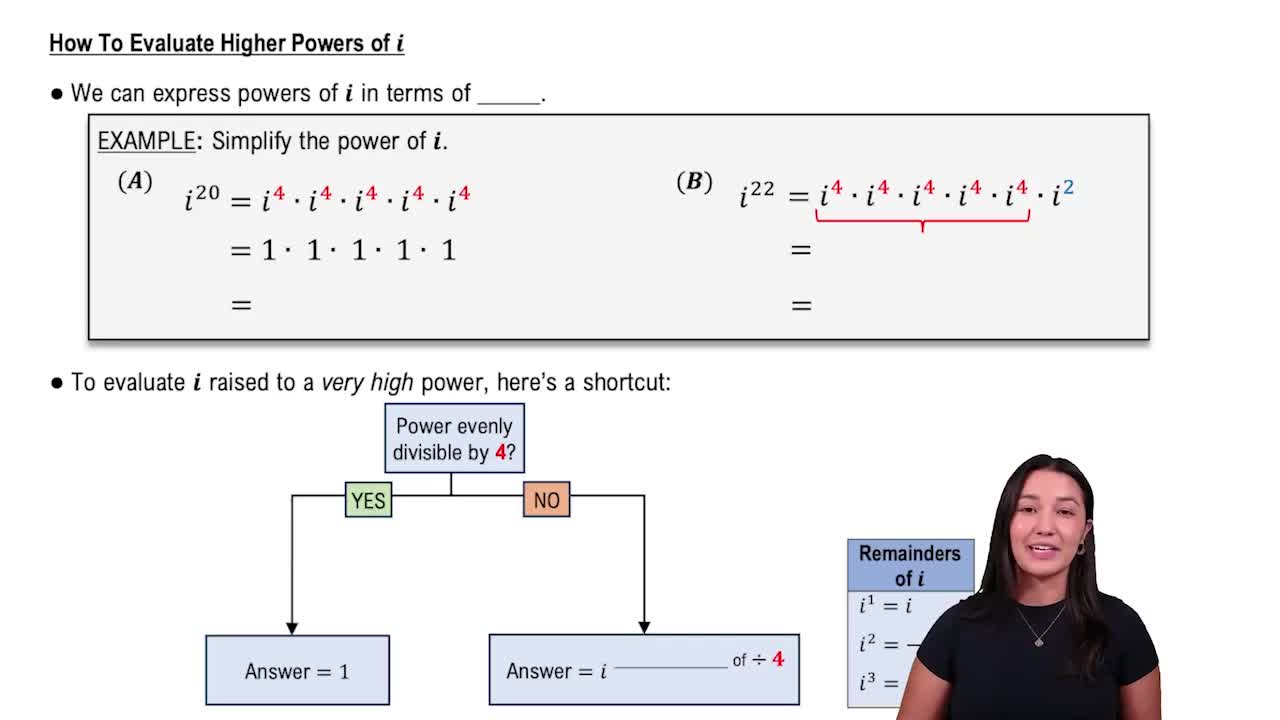
Higher Powers of i
Factoring Polynomials and Finding Zeros
Once a root is found using synthetic division, the quotient polynomial can be factored further or solved using other methods to find remaining zeros. This step breaks down the polynomial into simpler factors, allowing all roots (real or complex) to be identified.
Recommended video:
Guided course
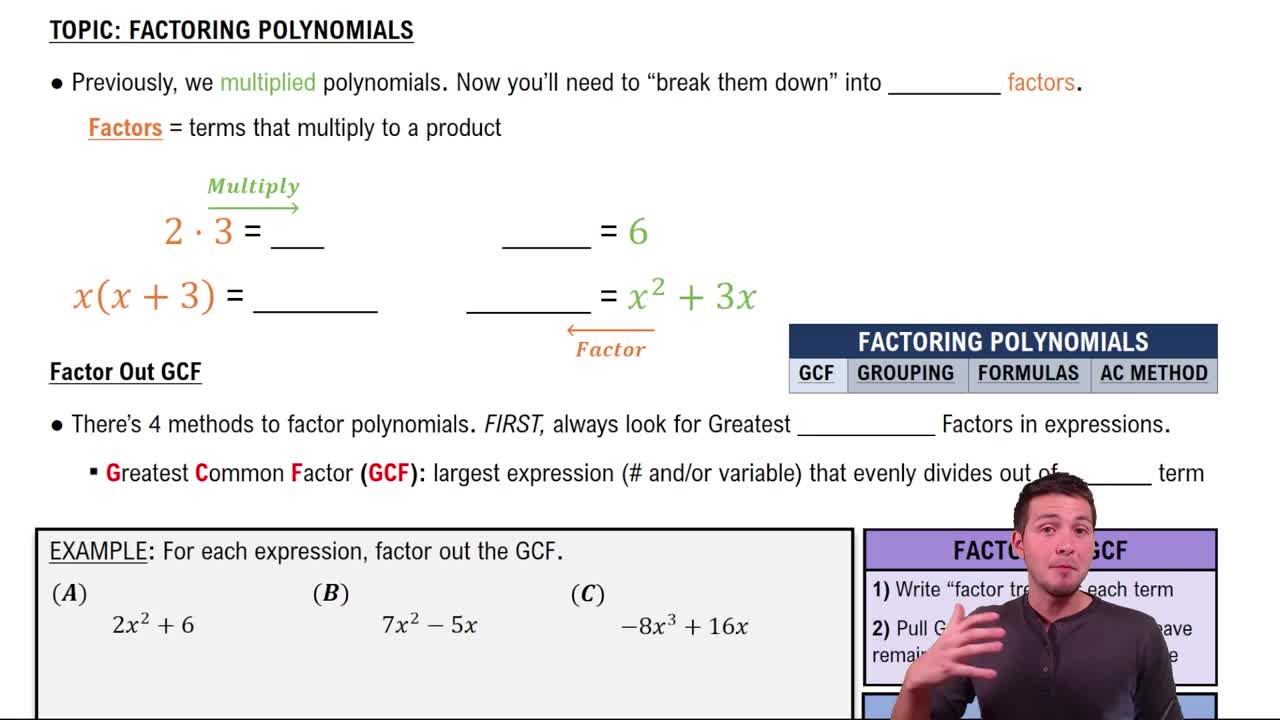
Introduction to Factoring Polynomials
Related Practice
Textbook Question
1105
views
Textbook Question
Determine which functions are polynomial functions. For those that are, identify the degree.
1196
views
Textbook Question
In Exercises 1–16, divide using long division. State the quotient, and the remainder, r(x). (3x2−2x+5)/(x−3)
635
views
1
rank
Textbook Question
Use the graph of the rational function in the figure shown to complete each statement in Exercises 9–14.
As ______
865
views
Textbook Question
Write an equation that expresses each relationship. Then solve the equation for y. x varies jointly as y and z.
534
views
Textbook Question
Use the Leading Coefficient Test to determine the end behavior of the graph of the given polynomial function. Then use this end behavior to match the polynomial function with its graph. [The graphs are labeled (a) through (d).]
a.b. c. d.
1202
views