Magnesium can be used as a 'getter' in evacuated enclosuresto react with the last traces of oxygen. (The magnesium isusually heated by passing an electric current through a wireor ribbon of the metal.) If an enclosure of 5.67 L has a partialpressure of O2 of 7.066 mPa at 30 °C, what mass of magnesiumwill react according to the following equation?2 Mg1s2 + O21g2¡2 MgO1s2
Verified step by step guidance
1
Identify the balanced chemical equation: \(2 \text{Mg}_{(s)} + \text{O}_2_{(g)} \rightarrow 2 \text{MgO}_{(s)}\).
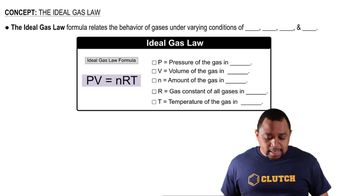
Calculate the number of moles of \(\text{O}_2\) using the ideal gas law: \(PV = nRT\). Convert the pressure from mPa to Pa and use \(R = 8.314 \text{ J/mol·K}\) and \(T = 30 + 273.15 \text{ K}\).
Use the stoichiometry of the balanced equation to find the moles of \(\text{Mg}\) needed. From the equation, 2 moles of \(\text{Mg}\) react with 1 mole of \(\text{O}_2\).
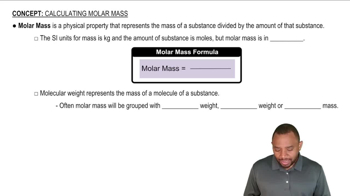
Calculate the mass of \(\text{Mg}\) using its molar mass (24.305 g/mol). Multiply the moles of \(\text{Mg}\) by its molar mass to find the mass.
Ensure all units are consistent and check calculations for accuracy.
Verified video answer for a similar problem:
This video solution was recommended by our tutors as helpful for the problem above.
Video duration:
3m
Play a video:
0 Comments
Was this helpful?
Key Concepts
Here are the essential concepts you must grasp in order to answer the question correctly.
Stoichiometry
Stoichiometry is the calculation of reactants and products in chemical reactions based on the balanced chemical equation. It allows us to determine the amount of a substance needed or produced in a reaction. In this case, the stoichiometric coefficients from the equation 2 Mg + O2 → 2 MgO indicate that two moles of magnesium react with one mole of oxygen, which is essential for calculating the mass of magnesium required.
The Ideal Gas Law relates the pressure, volume, temperature, and number of moles of a gas through the equation PV = nRT. This law is crucial for determining the number of moles of oxygen present in the enclosure at the given conditions. By using the partial pressure of O2 and the volume of the enclosure, we can calculate the moles of oxygen available for the reaction with magnesium.
Molar mass is the mass of one mole of a substance, typically expressed in grams per mole (g/mol). It is essential for converting between moles and grams when calculating the mass of magnesium needed for the reaction. For magnesium, the molar mass is approximately 24.31 g/mol, which will be used to find the total mass of magnesium that reacts with the calculated moles of oxygen.


 Verified step by step guidance

 01:16
01:16