Ch.18 - Thermodynamics: Entropy, Free Energy & Equilibrium
McMurry - Chemistry 8th Edition
McMurry8th EditionChemistryISBN: 9781292336145Not the one you use?Change textbook
Chapter 18, Problem 143k

Methanol (CH3OH) is made industrially in two steps from CO and H2. It is so cheap to make that it is being considered for use as a precursor to hydrocarbon fuels, such as methane (CH4):
Step 1. CO(g) + 2 H2(g) S CH3OH(l) ΔS° = - 332 J/K
Step 2. CH3OH1l2 → CH4(g) + 1/2 O2(g) ΔS° = 162 J/K
(k) Calculate an overall ΔG°, ΔH°, and ΔS° for the formation of CH4 from CO and H2.

Verified step by step guidance
1
Identify the given reactions and their respective \( \Delta S^\circ \) values: Step 1: \( \text{CO(g) + 2 H}_2\text{(g) } \rightarrow \text{ CH}_3\text{OH(l) } \Delta S^\circ = -332 \text{ J/K} \), Step 2: \( \text{CH}_3\text{OH(l) } \rightarrow \text{ CH}_4\text{(g) + } \frac{1}{2} \text{O}_2\text{(g) } \Delta S^\circ = 162 \text{ J/K} \).
To find the overall \( \Delta S^\circ \), add the \( \Delta S^\circ \) values of the two steps: \( \Delta S^\circ_{\text{overall}} = \Delta S^\circ_{\text{Step 1}} + \Delta S^\circ_{\text{Step 2}} \).
Use Hess's Law to determine \( \Delta H^\circ \) and \( \Delta G^\circ \) for each step if not given, or assume standard enthalpy and Gibbs free energy changes if provided.
Calculate the overall \( \Delta H^\circ \) and \( \Delta G^\circ \) by summing the values from each step: \( \Delta H^\circ_{\text{overall}} = \Delta H^\circ_{\text{Step 1}} + \Delta H^\circ_{\text{Step 2}} \) and \( \Delta G^\circ_{\text{overall}} = \Delta G^\circ_{\text{Step 1}} + \Delta G^\circ_{\text{Step 2}} \).
Ensure all units are consistent and check if any additional data or assumptions are needed to complete the calculations, such as standard enthalpies or Gibbs free energies of formation.

Key Concepts

Here are the essential concepts you must grasp in order to answer the question correctly.

Gibbs Free Energy (ΔG°)

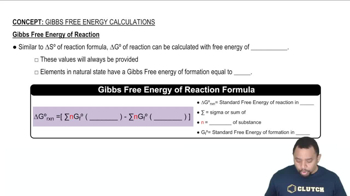
Gibbs Free Energy (ΔG°) is a thermodynamic potential that measures the maximum reversible work obtainable from a thermodynamic system at constant temperature and pressure. It is calculated using the equation ΔG° = ΔH° - TΔS°, where ΔH° is the change in enthalpy and ΔS° is the change in entropy. A negative ΔG° indicates that a reaction is spontaneous under standard conditions.
Recommended video:
Guided course
01:51
Gibbs Free Energy of Reactions

Enthalpy (ΔH°)

Enthalpy (ΔH°) is a measure of the total heat content of a system and reflects the energy required to break and form bonds during a chemical reaction. It is an important factor in determining the heat absorbed or released in a reaction. The overall ΔH° for a reaction can be calculated by summing the ΔH° values of individual steps, following Hess's law.

Entropy (ΔS°)

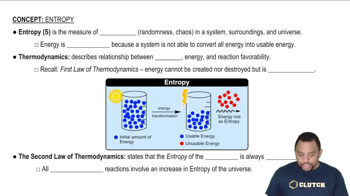
Entropy (ΔS°) is a measure of the disorder or randomness in a system. In chemical reactions, it reflects the distribution of energy among the particles and the number of ways the system can be arranged. A positive ΔS° indicates an increase in disorder, which often favors spontaneity, while a negative ΔS° suggests a decrease in disorder, which can hinder spontaneity.
Recommended video:
Guided course
02:46
Entropy in Thermodynamics