

Ch.4 - Reactions in Aqueous Solution
Brown - Chemistry: The Central Science 15th Edition
Brown15th EditionChemistry: The Central ScienceISBN: 9780137542970Not the one you use?Change textbook
Chapter 4, Problem 88b

A solution is made by mixing 15.0 g of Sr(OH)2 and 55.0 mL of 0.200 M HNO3. b. Calculate the concentration of each ion remaining in solution.

Verified step by step guidance
1
Determine the moles of Sr(OH)_2 using its molar mass.
Calculate the moles of HNO_3 using its concentration and volume.
Write the balanced chemical equation for the reaction: Sr(OH)_2 + 2HNO_3 → Sr(NO_3)_2 + 2H_2O.
Identify the limiting reactant by comparing the mole ratio from the balanced equation.
Calculate the concentration of each ion remaining in solution by considering the stoichiometry of the reaction and the total volume of the solution.

Key Concepts

Here are the essential concepts you must grasp in order to answer the question correctly.

Stoichiometry

Stoichiometry is the calculation of reactants and products in chemical reactions. It involves using balanced chemical equations to determine the relationships between the amounts of substances consumed and produced. In this question, stoichiometry will help in determining how much of each reactant reacts and what remains in solution after the reaction.
Recommended video:
Guided course
01:16
Stoichiometry Concept

Ion Concentration

Ion concentration refers to the amount of a specific ion present in a solution, typically expressed in molarity (M). To find the concentration of ions remaining after a reaction, one must consider the initial concentrations, the volume of the solution, and the stoichiometry of the reaction. This concept is crucial for calculating the final concentrations of Sr²⁺ and NO₃⁻ ions in the solution.
Recommended video:
Guided course
06:25
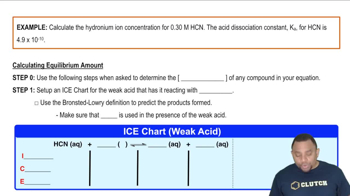
Hydronium Ion Concentration Example

Neutralization Reaction

A neutralization reaction occurs when an acid reacts with a base to produce water and a salt. In this case, HNO3 (an acid) reacts with Sr(OH)2 (a base) to form Sr(NO3)2 and water. Understanding this concept is essential for predicting the products of the reaction and determining how much of each reactant is left unreacted in the solution.
Recommended video:
Guided course
05:56
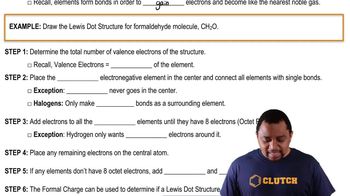
Lewis Dot Structures: Neutral Compounds
Related Practice
Textbook Question

A 0.5895-g sample of impure magnesium hydroxide is dissolved in 100.0 mL of 0.2050 M HCl solution. The excess acid then needs 19.85 mL of 0.1020 M NaOH for neutralization. Calculate the percentage by mass of magnesium hydroxide in the sample, assuming that it is the only substance reacting with the HCl solution.

1379
views
1
rank
Textbook Question

A solution of 100.0 mL of 0.200 M KOH is mixed with a solution of 200.0 mL of 0.150 M NiSO4. (a) Write the balanced chemical equation for the reaction that occurs.

407
views
Textbook Question

A 4.36-g sample of an unknown alkali metal hydroxide is dissolved in 100.0 mL of water. An acid–base indicator is added, and the resulting solution is titrated with 2.50 M HCl(aq) solution. The indicator changes color, signaling that the equivalence point has been reached, after 17.0 mL of the hydrochloric acid solution has been added. (b) What is the identity of the alkali metal cation: Li+, Na+, K+, Rb+, or Cs+?

455
views
Textbook Question

A solution of 100.0 mL of 0.200 M KOH is mixed with a solution of 200.0 mL of 0.150 M NiSO4. (b) What precipitate forms?

383
views
Textbook Question

A solution is made by mixing 15.0 g of Sr(OH)2 and 55.0 mL of 0.200 M HNO3. c. Is the resulting solution acidic or basic?


Textbook Question

A 1.248-g sample of limestone rock is pulverized and then treated with 30.00 mL of 1.035 M HCl solution. The excess acid then requires 11.56 mL of 1.010 M NaOH for neutralization. Calculate the percentage by mass of calcium carbonate in the rock, assuming that it is the only substance reacting with the HCl solution.

1098
views