

A 0.5895-g sample of impure magnesium hydroxide is dissolved in 100.0 mL of 0.2050 M HCl solution. The excess acid then needs 19.85 mL of 0.1020 M NaOH for neutralization. Calculate the percentage by mass of magnesium hydroxide in the sample, assuming that it is the only substance reacting with the HCl solution.

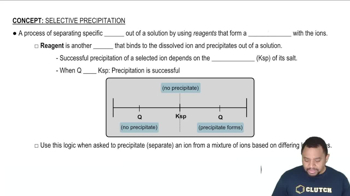
A solution of 100.0 mL of 0.200 M KOH is mixed with a solution of 200.0 mL of 0.150 M NiSO4. (b) What precipitate forms?
Verified step by step guidance
Verified video answer for a similar problem:
Key Concepts
Precipitation Reactions
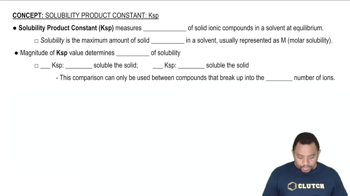
Solubility Product Constant (Ksp)
Stoichiometry of Reactions
The distinctive odor of vinegar is due to acetic acid, CH3COOH, which reacts with sodium hydroxide according to: CH3COOH1aq2 + NaOH1aq2¡ H2O1l2 + NaCH3COO1aq2 If 3.45 mL of vinegar needs 42.5 mL of 0.115 M NaOH to reach the equivalence point in a titration, how many grams of acetic acid are in a 1.00-qt sample of this vinegar?
A solution of 100.0 mL of 0.200 M KOH is mixed with a solution of 200.0 mL of 0.150 M NiSO4. (a) Write the balanced chemical equation for the reaction that occurs.
A solution is made by mixing 15.0 g of Sr(OH)2 and 55.0 mL of 0.200 M HNO3. b. Calculate the concentration of each ion remaining in solution.
A 4.36-g sample of an unknown alkali metal hydroxide is dissolved in 100.0 mL of water. An acid–base indicator is added, and the resulting solution is titrated with 2.50 M HCl(aq) solution. The indicator changes color, signaling that the equivalence point has been reached, after 17.0 mL of the hydrochloric acid solution has been added. (b) What is the identity of the alkali metal cation: Li+, Na+, K+, Rb+, or Cs+?
A solution is made by mixing 15.0 g of Sr(OH)2 and 55.0 mL of 0.200 M HNO3. c. Is the resulting solution acidic or basic?
