19. Chemical Thermodynamics
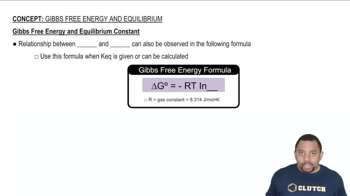
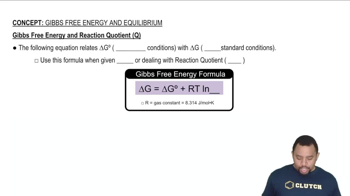
Gibbs Free Energy And Equilibrium
19. Chemical Thermodynamics
Gibbs Free Energy And Equilibrium
 01:19
01:19

Practice this topic
- Multiple Choice
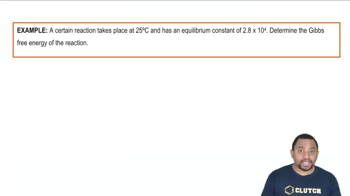
For reaction, Ag2CO3 (s) ⇌ Ag2O (s) + CO2 (g), the ∆Hº = 79.14 kJ/mol, ∆Sº = 167.2 J/mol*K.
Determine the equilibrium constant at which the temperature is 365.1 K.
1384views5rank2comments - Open Question
NaHCO3 ⇌ NaOH(s) + CO2(g) Calculate the value of the equilibrium constant.
998views - Open Question
Calculate the equilibrium constant at 25°C for a reaction for which ∆G° = -4.22 kcal/mol.
912views - Open Question
What is δg° for the following reaction at 25 °C? COBr2(g) ⇌ CO(g) + Br2(g) Kp = 4.11 × 10⁴
928views - Open Question
When two reactions are coupled in a cell, what determines if they will both proceed spontaneously?
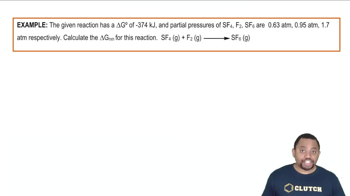
1040views - Multiple ChoiceAt 1120 K, ΔG° = 78.9 kJ/mol for the reaction 3 A (g) + B (g) → 2 C (g). If the partial pressures of A, B, and C are 11.5 atm, 8.60 atm, and 0.510 atm respectively, what is the Gibbs free energy change (ΔG) for this reaction under these conditions?899views
- Multiple ChoiceCalculate the Gibbs free energy change (ΔG_rxn) at 298 K for the reaction N2 (g) + 3 H2 (g) ⇌ 2 NH3 (g) given the standard Gibbs free energy change (ΔG° = -33.3 kJ) and the partial pressures: P(N2) = 1.5 atm, P(H2) = 4.5 atm, P(NH3) = 6.0 atm.881views
- Multiple ChoiceCalculate the Gibbs free energy change (ΔGᵣₓₙ) at 298 K for the reaction N₂ (g) + 3 H₂ (g) ⇌ 2 NH₃ (g) given the standard Gibbs free energy change (ΔG° = -33.3 kJ) and the partial pressures: P(N₂) = 1.5 atm, P(H₂) = 4.5 atm, P(NH₃) = 1.0 atm.782views