 Back
Back
Problem 87d
Suppose a scientist repeats the Millikan oil-drop experiment but reports the charges on the drops using an unusual (and imaginary) unit called the warmomb (wa). The scientist obtains the following data for four of the drops: Droplet Calculated Charge (wa) A 3.84⨉10−8 B 4.80⨉10−8 C 2.88⨉10−8 D 8.64⨉10−8 (d) What is the conversion factor between warmombs and coulombs?
Problem 88a
The natural abundance of 3He is 0.000137%. (a) How many protons, neutrons, and electrons are in an atom of 3He?
Problem 88b
The natural abundance of 3He is 0.000137%. (b) Based on the sum of the masses of their subatomic particles, which is expected to be more massive, an atom of 3He or an atom of 3H (which is also called tritium)?
- A cube of gold that is 1.00 cm on a side has a mass of 19.3 g. A single gold atom has a mass of 197.0 u. (c) What assumptions did you make in arriving at your answer for part (b)?
Problem 89
Problem 89a
A cube of gold that is 1.00 cm on a side has a mass of 19.3 g. A single gold atom has a mass of 197.0 u. (a) How many gold atoms are in the cube?
Problem 89b
A cube of gold that is 1.00 cm on a side has a mass of 19.3 g. A single gold atom has a mass of 197.0 u. (b) From the information given, estimate the diameter in Å of a single gold atom.
Problem 90a
The diameter of a rubidium atom is 495 pm We will consider two different ways of placing the atoms on a surface. In arrangement A, all the atoms are lined up with one another to form a square grid. Arrangement B is called a close-packed arrangement because the atoms sit in the 'depressions' formed by the previous row of atoms: (a) Using arrangement A, how many Rb atoms could be placed on a square surface that is 1.0 cm on a side?
Problem 90c2
"The diameter of a rubidium atom is 495 pm We will consider two different ways of placing the atoms on a surface. In arrangement A, all the atoms are lined up with one another to form a square grid. Arrangement B is called a close-packed arrangement because the atoms sit in the 'depressions' formed by the previous row of atoms:

(c) If extended to three dimensions, which arrangement would lead to a greater density for Rb metal?"
Problem 90c1
"The diameter of a rubidium atom is 495 pm We will consider two different ways of placing the atoms on a surface. In arrangement A, all the atoms are lined up with one another to form a square grid. Arrangement B is called a close-packed arrangement because the atoms sit in the 'depressions' formed by the previous row of atoms:
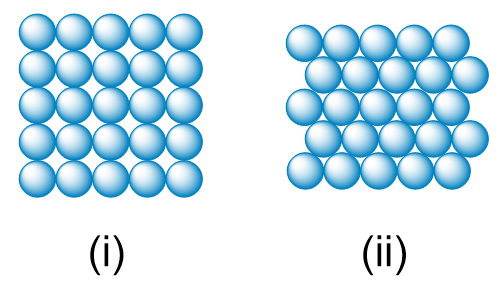
(c) By what factor has the number of atoms on the surface increased in going to arrangement B from arrangement A?
Problem 91a
(a) Assuming the dimensions of the nucleus and atom shown in Figure 2.10, what fraction of the volume of the atom is taken up by the nucleus?
Problem 91b
(b) Using the mass of the proton from Table 2.1 and assuming its diameter is 1.0 * 10-15 m, calculate the density of a proton in g>cm3.
Problem 92a
Identify the element represented by each of the following symbols and give the number of protons and neutrons in each: (a) 7433X
Problem 93b
The nucleus of 6Li is a powerful absorber of neutrons. It exists in the naturally occurring metal to the extent of 7.5%. In the era of nuclear deterrence, large quantities of lithium were processed to remove 6Li for use in hydrogen bomb production. The lithium metal remaining after removal of 6Li was sold on the market. (b) The atomic masses of 6Li and 7Li are 6.015122 and 7.016004 u, respectively. A sample of lithium depleted in the lighter isotope was found on analysis to contain 1.442% 6Li. What is the average atomic weight of this sample of the metal?
Problem 94a
The element argon has three naturally occurring isotopes, with 18, 20, and 22 neutrons in the nucleus, respectively. (a) Write the full chemical symbols for these three isotopes.
Problem 95
The element chromium (Cr) consists of four naturally occurring isotopes with atomic masses 49.9460, 51.9405, 52.9407, and 53.9389 u. The relative abundances of these four isotopes are 4.3, 83.8, 9.5, and 2.4%, respectively. From these data, calculate the atomic weight of chromium.
Problem 96
Copper (Cu) consists of two naturally occurring isotopes with masses of 62.9296 and 64.9278 u. (a) How many protons and neutrons are in the nucleus of each isotope? Write the complete atomic symbol for each, showing the atomic number and mass number. (b) The average atomic mass of Cu is 63.55 u. Calculate the abundance of each isotope.
- Using a suitable reference such as the CRC Handbook of Chemistry and Physics or http://www.webelements.com, look up the following information for nickel: (b) the atomic masses (in u), (c) the natural abundances of the five most abundant isotopes.
Problem 97
Problem 98a
There are two different isotopes of bromine atoms. Under normal conditions, elemental bromine consists of Br2 molecules, and the mass of a Br2 molecule is the sum of the masses of the two atoms in the molecule. The mass spectrum of Br2 consists of three peaks: Mass (u) Relative Size 157.836 0.2569 159.834 0.4999 161.832 0.2431 (a) What is the origin of each peak (of what isotopes does each consist)?
Problem 98b
There are two different isotopes of bromine atoms. Under normal conditions, elemental bromine consists of Br2 molecules, and the mass of a Br2 molecule is the sum of the masses of the two atoms in the molecule. The mass spectrum of Br2 consists of three peaks: Mass (u) Relative Size 157.836 0.2569 159.834 0.4999 161.832 0.2431 (b) What is the mass of each isotope?
Problem 98c
There are two different isotopes of bromine atoms. Under normal conditions, elemental bromine consists of Br2 molecules, and the mass of a Br2 molecule is the sum of the masses of the two atoms in the molecule. The mass spectrum of Br2 consists of three peaks: Mass (u) Relative Size 157.836 0.2569 159.834 0.4999 161.832 0.2431 (c) Determine the average molecular mass of a Br2 molecule.
Problem 98d
There are two different isotopes of bromine atoms. Under normal conditions, elemental bromine consists of Br2 molecules, and the mass of a Br2 molecule is the sum of the masses of the two atoms in the molecule. The mass spectrum of Br2 consists of three peaks: Mass (u) Relative Size 157.836 0.2569 159.834 0.4999 161.832 0.2431 (d) Determine the average atomic mass of a bromine atom
Problem 98e
There are two different isotopes of bromine atoms. Under normal conditions, elemental bromine consists of Br2 molecules, and the mass of a Br2 molecule is the sum of the masses of the two atoms in the molecule. The mass spectrum of Br2 consists of three peaks: Mass (u) Relative Size 157.836 0.2569 159.834 0.4999 161.832 0.2431 (e) Calculate the abundances of the two isotopes. Calculate the abundance of the heavier isotope.
Problem 99b
It is common in mass spectrometry to assume that the mass of a cation is the same as that of its parent atom. (b) What percentage of the mass of an 1H atom does the electron represent?
Problem 100
From the following list of elements—Mg, Li, Tl, Pb, Se, Cl, Xe, Si, C—pick the one that best fits each description. Use each element only once: (a) an alkali metal, (b) an alkaline earth metal, (c) a noble gas, (d) a halogen, (e) a metalloidin group 14, (f) a nonmetal listed in group 14, (g) a metal that forms a 3+ ion, (h) a nonmetal that forms a 2- ion, (i) an element that is used as radiation shielding.
Problem 101a
The first atoms of seaborgium (Sg) were identified in 1974. The longest-lived isotope of Sg has a mass number of 266. (a) How many protons, electrons, and neutrons are in an 266Sg atom?
Problem 101b
The first atoms of seaborgium (Sg) were identified in 1974. The longest-lived isotope of Sg has a mass number of 266. (b) Atoms of Sg are very unstable, and it is therefore difficult to study this element's properties. Based on the position of Sg in the periodic table, what element should it most closely resemble in its chemical properties?
- The explosion of an atomic bomb releases many radioactive isotopes, including strontium-90. Considering the location of strontium in the periodic table, suggest a reason why this isotope is particularly dangerous for human health.
Problem 102
- Calculate the value of the silver in the American Silver Eagle coin, assuming its thickness is uniform, given that it has a diameter of 41 mm, a thickness of 2.5 mm, a silver density of 10.5 g/cm3, and the approximate market price of silver is $0.51 per gram.
Problem 104
Problem 105
From the molecular structures shown here, identify the one that corresponds to each of the following species: (a) chlorine gas; (b) propane; (c) nitrate ion; (d) sulfur trioxide; (e) methyl chloride, CH3Cl.

- Name each of the following chlorides. Assuming that the compounds are ionic, what charge is associated with the metallic element in each case? (a) AgCl (b) TiCl₄ (c) IrCl₃ (d) LiCl.
Problem 106