
Ch.10 - Gases
Brown - Chemistry: The Central Science 15th Edition
Brown15th EditionChemistry: The Central ScienceISBN: 9780137542970Not the one you use?Change textbook
Chapter 10, Problem 67

A piece of dry ice (solid carbon dioxide) with a mass of 5.50 g is placed in a 10.0-L vessel that already contains air at 705 torr and 24°C. After the carbon dioxide has totally sublimed, what is the partial pressure of the resultant CO2 gas, and the total pressure in the container, at 24°C?

Verified step by step guidance
1
Convert the mass of dry ice (solid CO2) to moles using the molar mass of CO2 (44.01 g/mol).
Use the ideal gas law, PV = nRT, to calculate the partial pressure of CO2. Here, P is the pressure, V is the volume (10.0 L), n is the number of moles of CO2, R is the ideal gas constant (0.0821 L·atm/mol·K), and T is the temperature in Kelvin (24°C + 273.15).
Convert the initial pressure of air from torr to atm (1 atm = 760 torr) to ensure consistent units.
Calculate the total pressure in the container by adding the partial pressure of CO2 to the initial pressure of the air (in atm).
Convert the total pressure back to torr if needed, using the conversion factor (1 atm = 760 torr).

Verified video answer for a similar problem:

This video solution was recommended by our tutors as helpful for the problem above.
Video duration:
3m
Was this helpful?

Key Concepts

Here are the essential concepts you must grasp in order to answer the question correctly.

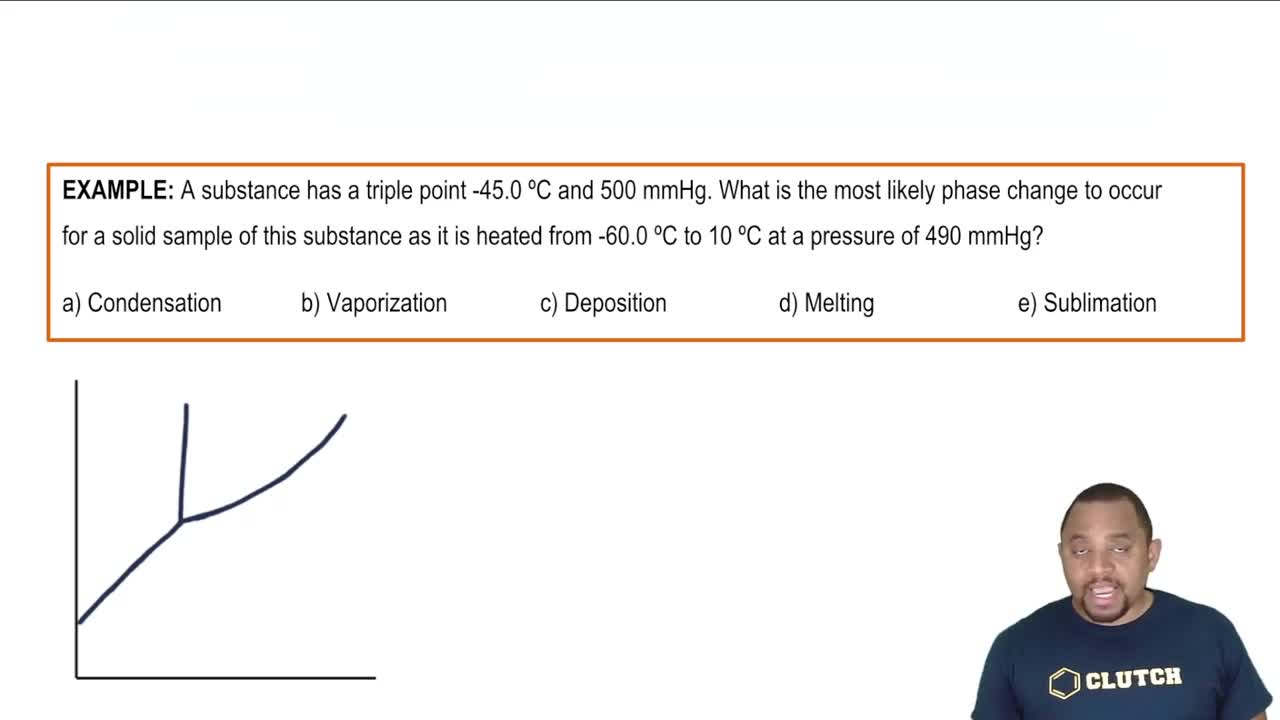
Sublimation

Sublimation is the phase transition in which a substance changes directly from a solid to a gas without passing through the liquid phase. In this context, dry ice (solid CO2) sublimates into gaseous CO2 when placed in the vessel, contributing to the total pressure in the container.
Recommended video:
Guided course
01:52
Sublimation Phase Change Example

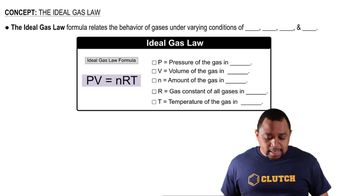
Ideal Gas Law

The Ideal Gas Law, expressed as PV = nRT, relates the pressure (P), volume (V), number of moles (n), the ideal gas constant (R), and temperature (T) of a gas. This law is essential for calculating the partial pressure of the CO2 gas produced from the sublimation of dry ice in the given volume at a specific temperature.
Recommended video:
Guided course
01:15
Ideal Gas Law Formula

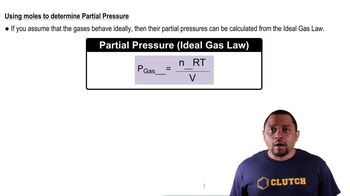
Partial Pressure

Partial pressure is the pressure exerted by a single component of a gas mixture. According to Dalton's Law, the total pressure in a container is the sum of the partial pressures of all gases present. In this scenario, after the sublimation of dry ice, the partial pressure of CO2 must be calculated and then added to the existing air pressure to find the total pressure in the vessel.
Recommended video:
Guided course
00:48
Partial Pressure Calculation