
Textbook Question
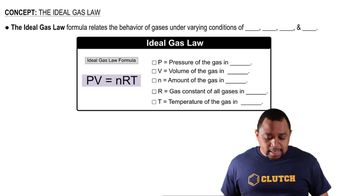
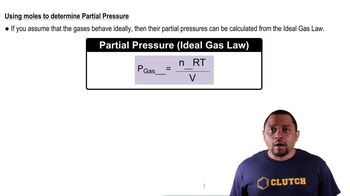
At an underwater depth of 250 ft, the pressure is 8.38 atm. What should the mole percent of oxygen be in the diving gas for the partial pressure of oxygen in the mixture to be 0.21 atm, the same as in air at 1 atm?

 Verified step by step guidance
 01:15
01:15
 00:48
00:48 03:12
03:12At an underwater depth of 250 ft, the pressure is 8.38 atm. What should the mole percent of oxygen be in the diving gas for the partial pressure of oxygen in the mixture to be 0.21 atm, the same as in air at 1 atm?
The atmospheric concentration of CO2 gas is presently 407 ppm (parts per million, by volume; that is, 407 L of every 106 L of the atmosphere are CO2). What is the mole fraction of CO2 in the atmosphere?.
(a) What are the mole fractions of N2 in a mixture of 15.08 g of O2, 8.17 g of N2, and 2.64 g of H2?
A rigid vessel containing a 3:1 mol ratio of carbon dioxide and water vapor is held at 200°C where it has a total pressure of 2.00 atm. If the vessel is cooled to 10°C so that all of the water vapor condenses, what is the pressure of carbon dioxide? Neglect the volume of the liquid water that forms on cooling.
A piece of dry ice (solid carbon dioxide) with a mass of 5.50 g is placed in a 10.0-L vessel that already contains air at 705 torr and 24°C. After the carbon dioxide has totally sublimed, what is the partial pressure of the resultant CO2 gas, and the total pressure in the container, at 24°C?