
Ch.10 - Gases
Brown - Chemistry: The Central Science 15th Edition
Brown15th EditionChemistry: The Central ScienceISBN: 9780137542970Not the one you use?Change textbook
Chapter 10, Problem 71

At an underwater depth of 250 ft, the pressure is 8.38 atm. What should the mole percent of oxygen be in the diving gas for the partial pressure of oxygen in the mixture to be 0.21 atm, the same as in air at 1 atm?

Verified step by step guidance
1
Identify the total pressure at the given depth, which is 8.38 atm.
Recognize that the partial pressure of oxygen desired is 0.21 atm.
Use Dalton's Law of Partial Pressures, which states that the partial pressure of a gas in a mixture is equal to the mole fraction of the gas times the total pressure.
Set up the equation for the partial pressure of oxygen: \( P_{\text{O}_2} = X_{\text{O}_2} \times P_{\text{total}} \), where \( P_{\text{O}_2} = 0.21 \text{ atm} \) and \( P_{\text{total}} = 8.38 \text{ atm} \).
Solve for the mole fraction of oxygen, \( X_{\text{O}_2} = \frac{0.21}{8.38} \), and then convert this mole fraction to a mole percent by multiplying by 100.

Verified video answer for a similar problem:

This video solution was recommended by our tutors as helpful for the problem above.
Video duration:
1m
Was this helpful?

Key Concepts

Here are the essential concepts you must grasp in order to answer the question correctly.

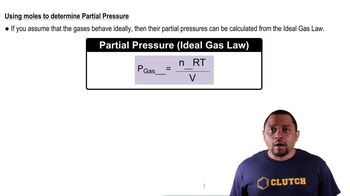
Partial Pressure

Partial pressure refers to the pressure exerted by a single component of a gas mixture. According to Dalton's Law of Partial Pressures, the total pressure of a gas mixture is the sum of the partial pressures of each individual gas. In this context, understanding how to calculate the partial pressure of oxygen in a diving gas mixture is essential for determining the appropriate mole percent of oxygen.
Recommended video:
Guided course
00:48
Partial Pressure Calculation

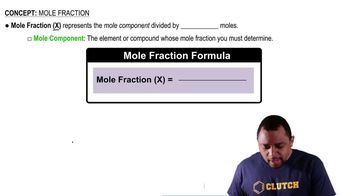
Mole Fraction

Mole fraction is a way of expressing the concentration of a component in a mixture, defined as the ratio of the number of moles of that component to the total number of moles of all components. In the context of gas mixtures, the mole fraction can be used to calculate the partial pressure of a gas, as it directly relates to how much of that gas is present in the mixture compared to others.
Recommended video:
Guided course
00:36
Mole Fraction Formula

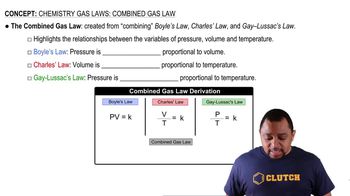
Gas Laws

Gas laws describe the behavior of gases under various conditions of pressure, volume, and temperature. The Ideal Gas Law (PV=nRT) is particularly relevant here, as it relates the pressure, volume, and temperature of a gas to the number of moles. Understanding these laws helps in calculating how changes in pressure at different depths affect the composition of diving gases.
Recommended video:
Guided course
01:43
Combined Gas Law
Related Practice
Textbook Question

A sample of 5.00 mL of diethyl ether (C2H5OC2H5,density=0.7134 g/mL) is introduced into a 6.00-L vessel that already contains a mixture of N2 and O2, whose partial pressures are 𝑃N2=0.751atm and 𝑃O2=0.208atm. The temperature is held at 35.0°C, and the diethyl ether totally evaporates. b. Calculate the total pressure in the container.

Textbook Question

(a) What are the mole fractions of H2 in a mixture of 15.08 g of O2, 8.17 g of N2, and 2.64 g of H2?

774
views
Textbook Question

(a) What are the mole fractions of N2 in a mixture of 15.08 g of O2, 8.17 g of N2, and 2.64 g of H2?

884
views
Textbook Question

A quantity of N2 gas originally held at 5.25 atm pressure in a 1.00-L container at 26°C is transferred to a 12.5-L container at 20°C. A quantity of O2 gas originally at 5.25 atm and 26°C in a 5.00-L container is transferred to this same container. What is the total pressure in the new container?

Textbook Question

A rigid vessel containing a 3:1 mol ratio of carbon dioxide and water vapor is held at 200°C where it has a total pressure of 2.00 atm. If the vessel is cooled to 10°C so that all of the water vapor condenses, what is the pressure of carbon dioxide? Neglect the volume of the liquid water that forms on cooling.

Textbook Question

A piece of dry ice (solid carbon dioxide) with a mass of 5.50 g is placed in a 10.0-L vessel that already contains air at 705 torr and 24°C. After the carbon dioxide has totally sublimed, what is the partial pressure of the resultant CO2 gas, and the total pressure in the container, at 24°C?