Cyclopropane, a gas used with oxygen as a general anesthetic, is composed of 85.7% C and 14.3% H by mass. a. If 1.56 g of cyclopropane has a volume of 1.00 L at 0.984 atm and 50.0°C, what is the molecular formula of cyclopropane?

Ch.10 - Gases

Brown15th EditionChemistry: The Central ScienceISBN: 9780137542970Not the one you use?Change textbook
Chapter 10, Problem 107f
Consider the following gases, all at STP: Ne, SF6, N2, CH4. (f) Which one would effuse more rapidly than N2?
Verified step by step guidance1
Identify the concept of effusion and relate it to Graham's law, which states that the rate of effusion of a gas is inversely proportional to the square root of its molar mass.
List the molar masses of the given gases: Ne (Neon), SF_6 (Sulfur hexafluoride), N_2 (Nitrogen), and CH_4 (Methane).
Calculate the molar mass of each gas: Ne = 20.18 g/mol, SF_6 = 146.06 g/mol, N_2 = 28.02 g/mol, CH_4 = 16.04 g/mol.
Compare the molar masses of the gases to that of N_2. According to Graham's law, a gas with a lower molar mass than N_2 will effuse more rapidly.
Determine which gas has a molar mass less than that of N_2 and conclude that this gas will effuse more rapidly than N_2.

Verified video answer for a similar problem:
This video solution was recommended by our tutors as helpful for the problem above.
Video duration:
1mWas this helpful?
Key Concepts
Here are the essential concepts you must grasp in order to answer the question correctly.
Graham's Law of Effusion
Graham's Law states that the rate of effusion of a gas is inversely proportional to the square root of its molar mass. This means that lighter gases effuse more quickly than heavier gases. For example, if comparing nitrogen (N2) with other gases, the gas with a lower molar mass than nitrogen will effuse more rapidly.
Recommended video:
Guided course
Graham's Law of Effusion
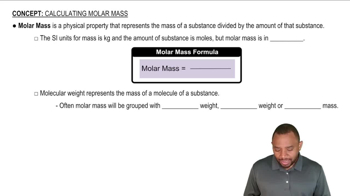
Molar Mass
Molar mass is the mass of one mole of a substance, typically expressed in grams per mole (g/mol). It is a critical factor in determining the rate of effusion according to Graham's Law. In this context, knowing the molar masses of Ne, SF6, N2, and CH4 allows us to predict which gas will effuse faster than nitrogen.
Recommended video:
Guided course
Molar Mass Concept
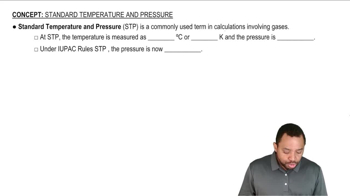
Standard Temperature and Pressure (STP)
Standard Temperature and Pressure (STP) is defined as a temperature of 0 degrees Celsius (273.15 K) and a pressure of 1 atmosphere (atm). At STP, the behavior of gases can be compared more easily, as their properties are standardized. This context is essential for analyzing the effusion rates of the gases mentioned in the question.
Recommended video:
Guided course
Standard Temperature and Pressure
Related Practice
Textbook Question
Textbook Question
Consider the following gases, all at STP: Ne, SF6, N2, CH4. (d) Which one has the highest total molecular volume relative to the space occupied by the gas?
626
views
Textbook Question
Consider the following gases, all at STP: Ne, SF6, N2, CH4. (g) Which one would have the largest van der Waals b parameter?
682
views
Textbook Question
Consider the following gases, all at STP: Ne, SF6, N2, CH4. (a) Which gas is most likely to depart from the assumption of the kinetic-molecular theory that says there are no attractive or repulsive forces between molecules?
1083
views
Textbook Question
You have a sample of gas at −33°C. You wish to increase the rms speed by a factor of 2. To what temperature should the gas be heated?
2
views