
An herbicide is found to contain only C, H, N, and Cl. The complete combustion of a 100.0-mg sample of the herbicide in excess oxygen produces 83.16 mL of CO2 and 73.30 mL of H2O vapor expressed at STP. A separate analysis shows that the sample also contains 16.44 mg of Cl. (c) What other information would you need to know about this compound to calculate its true molecular formula?
Ch.10 - Gases

Brown15th EditionChemistry: The Central ScienceISBN: 9780137542970Not the one you use?Change textbook
Chapter 10, Problem 110a
Cyclopropane, a gas used with oxygen as a general anesthetic, is composed of 85.7% C and 14.3% H by mass. a. If 1.56 g of cyclopropane has a volume of 1.00 L at 0.984 atm and 50.0°C, what is the molecular formula of cyclopropane?
Verified step by step guidance1
Calculate the molar mass of cyclopropane using the ideal gas law: PV = nRT. Rearrange to find n (moles of gas): n = PV / RT.
Use the given conditions: P = 0.984 atm, V = 1.00 L, R = 0.0821 L·atm/mol·K, and T = 50.0°C (convert to Kelvin by adding 273.15).
Calculate the molar mass (M) of cyclopropane using the formula: M = mass / n, where mass = 1.56 g.
Determine the empirical formula by converting the percentage composition to moles: 85.7% C and 14.3% H. Assume 100 g of cyclopropane, which gives 85.7 g C and 14.3 g H.
Convert grams to moles: moles of C = 85.7 g / 12.01 g/mol, moles of H = 14.3 g / 1.008 g/mol. Find the simplest whole number ratio of moles to determine the empirical formula. Compare the empirical formula mass to the molar mass to find the molecular formula.

Verified video answer for a similar problem:
This video solution was recommended by our tutors as helpful for the problem above.
Video duration:
13mWas this helpful?
Key Concepts
Here are the essential concepts you must grasp in order to answer the question correctly.
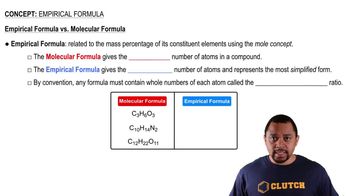
Empirical and Molecular Formulas
The empirical formula represents the simplest whole-number ratio of elements in a compound, while the molecular formula indicates the actual number of atoms of each element in a molecule. To determine the molecular formula, one often starts with the empirical formula, which can be derived from the mass percentages of the elements present.
Recommended video:
Guided course
Empirical vs Molecular Formula
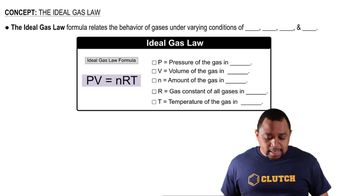
Ideal Gas Law
The Ideal Gas Law, expressed as PV = nRT, relates the pressure (P), volume (V), number of moles (n), gas constant (R), and temperature (T) of an ideal gas. This law is essential for calculating the number of moles of a gas from its volume, pressure, and temperature, which is necessary for determining the molecular formula of cyclopropane in this scenario.
Recommended video:
Guided course
Ideal Gas Law Formula
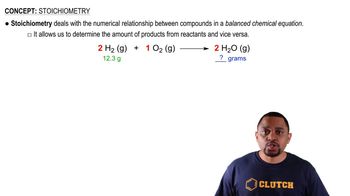
Stoichiometry
Stoichiometry involves the calculation of reactants and products in chemical reactions based on the conservation of mass. In this context, it helps in converting the mass of cyclopropane to moles, which is crucial for finding the molecular formula after determining the empirical formula from the mass composition.
Recommended video:
Guided course
Stoichiometry Concept
Related Practice
Textbook Question
679
views
Textbook Question
Consider the following gases, all at STP: Ne, SF6, N2, CH4. (d) Which one has the highest total molecular volume relative to the space occupied by the gas?
626
views
Textbook Question
Consider the following gases, all at STP: Ne, SF6, N2, CH4. (g) Which one would have the largest van der Waals b parameter?
682
views
Textbook Question
Consider the following gases, all at STP: Ne, SF6, N2, CH4. (f) Which one would effuse more rapidly than N2?
472
views
Textbook Question
An herbicide is found to contain only C, H, N, and Cl. The complete combustion of a 100.0-mg sample of the herbicide in excess oxygen produces 83.16 mL of CO2 and 73.30 mL of H2O vapor expressed at STP. A separate analysis shows that the sample also contains 16.44 mg of Cl. (b) Calculate its empirical formula.
1707
views
