
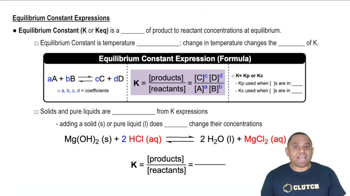
At 80°C, 𝐾𝑐 = 1.87×10⁻³ for the reaction PH3BCl3(𝑠) ⇌ PH3(𝑔) + BCl3(𝑔) (a) Calculate the equilibrium concentrations of PH3 and BCl3 if a solid sample of PH3BCl3 is placed in a closed vessel at 80°C and decomposes until equilibrium is reached.

At 1285 _x001F_C, the equilibrium constant for the reaction Br2(g) ⇌ 2 Br(g) is Kc = 1.04 * 10^-3. A 0.200-L vessel containing an equilibrium mixture of the gases has 0.245 g of Br2(g) in it. What is the mass of Br(g) in the vessel?
Verified step by step guidanceKey Concepts
Equilibrium Constant (Kc)
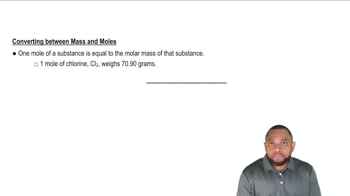
Molar Mass and Mass to Moles Conversion
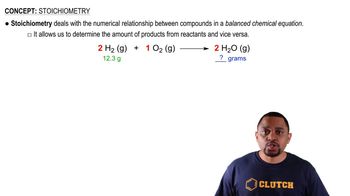
Stoichiometry in Chemical Reactions
At 900 K, the following reaction has 𝐾𝑝 = 0.345: 2 SO2(𝑔) + O2(𝑔) ⇌ 2 SO3(𝑔) In an equilibrium mixture the partial pressures of SO2 and O2 are 0.135 atm and 0.455 atm, respectively. What is the equilibrium partial pressure of SO3 in the mixture?
At 80°C, 𝐾𝑐 = 1.87×10⁻³ for the reaction PH3BCl3(𝑠) ⇌ PH3(𝑔) + BCl3(𝑔) (a) Calculate the equilibrium concentrations of PH3 and BCl3 if a solid sample of PH3BCl3 is placed in a closed vessel at 80°C and decomposes until equilibrium is reached. (b) If the flask has a volume of 0.250 L, what is the minimum mass of PH3BCl3(𝑠) that must be added to the flask to achieve equilibrium?
At 100°C, the equilibrium constant for the reaction COCl2(𝑔) ⇌ CO(𝑔) + Cl2(𝑔) has the value 𝐾𝑐 = 2.19×10⁻¹⁰. Are the following mixtures of COCl2, CO, and Cl2 at 100°C at equilibrium? If not, indicate the direction that the reaction must proceed to achieve equilibrium.
(a) [COCl2] = 2.00×10⁻³ M, [CO] = 3.3×10⁻⁶ M, [Cl2] = 6.62×10⁻⁶ M
(b) [COCl2] = 4.50×10⁻² M, [CO] = 1.1×10⁻⁷ M, [Cl2] = 2.25×10⁻⁶ M
(c) [COCl2] = 0.0100 M, [CO] = [Cl2] = 1.48×10⁻⁶ M
