

At 80°C, 𝐾𝑐 = 1.87×10⁻³ for the reaction PH3BCl3(𝑠) ⇌ PH3(𝑔) + BCl3(𝑔) (a) Calculate the equilibrium concentrations of PH3 and BCl3 if a solid sample of PH3BCl3 is placed in a closed vessel at 80°C and decomposes until equilibrium is reached.
Ch.15 - Chemical Equilibrium

Brown15th EditionChemistry: The Central ScienceISBN: 9780137542970Not the one you use?Change textbook
Chapter 15, Problem 48
For the reaction H2(g) + I2(g) ⇌ 2 HI(g), Kc = 55.3 at 700 K. In a 2.00-L flask containing an equilibrium mixture of the three gases, there are 0.056 g H2 and 4.36 g I2. What is the mass of HI in the flask?
Verified step by step guidance1
Step 1: Convert the mass of H2 and I2 to moles using their molar masses. The molar mass of H2 is approximately 2.02 g/mol, and the molar mass of I2 is approximately 253.8 g/mol.
Step 2: Calculate the concentrations of H2 and I2 in the flask by dividing the number of moles of each gas by the volume of the flask (2.00 L).
Step 3: Use the equilibrium constant expression for the reaction, Kc = [HI]^2 / ([H2][I2]), to set up an equation. Substitute the known values of Kc, [H2], and [I2] into this expression.
Step 4: Solve the equation for [HI], the concentration of HI at equilibrium.
Step 5: Convert the concentration of HI to mass by multiplying the concentration by the volume of the flask and the molar mass of HI (approximately 127.9 g/mol).
Key Concepts
Here are the essential concepts you must grasp in order to answer the question correctly.
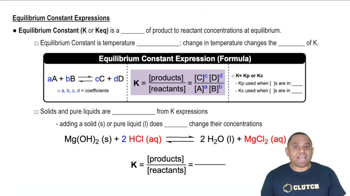
Equilibrium Constant (Kc)
The equilibrium constant, Kc, quantifies the ratio of the concentrations of products to reactants at equilibrium for a given reaction at a specific temperature. For the reaction H2(g) + I2(g) ⇌ 2 HI(g), Kc = [HI]^2 / ([H2][I2]). A higher Kc value indicates a greater concentration of products at equilibrium, which is essential for determining the amounts of substances in the reaction.
Recommended video:
Guided course
Equilibrium Constant Expressions
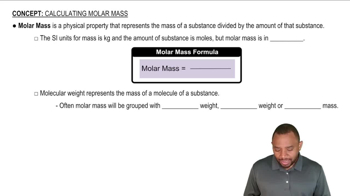
Molar Mass and Conversions
To find the mass of HI in the flask, it is crucial to convert the given masses of H2 and I2 into moles using their molar masses (H2: 2.02 g/mol, I2: 253.8 g/mol). This conversion allows for the calculation of the initial concentrations of the reactants, which can then be used to determine the equilibrium concentrations of all species involved in the reaction.
Recommended video:
Guided course
Molar Mass Concept
Stoichiometry of the Reaction
Stoichiometry refers to the quantitative relationship between reactants and products in a chemical reaction. In this case, the balanced equation shows that one mole of H2 reacts with one mole of I2 to produce two moles of HI. Understanding this ratio is essential for calculating the amount of HI produced based on the initial amounts of H2 and I2 present in the flask.
Recommended video:
Guided course
Stoichiometry Concept
Related Practice
Textbook Question
496
views
Textbook Question
At 900 K, the following reaction has 𝐾𝑝 = 0.345: 2 SO2(𝑔) + O2(𝑔) ⇌ 2 SO3(𝑔) In an equilibrium mixture the partial pressures of SO2 and O2 are 0.135 atm and 0.455 atm, respectively. What is the equilibrium partial pressure of SO3 in the mixture?
1046
views
Textbook Question
At 80°C, 𝐾𝑐 = 1.87×10⁻³ for the reaction PH3BCl3(𝑠) ⇌ PH3(𝑔) + BCl3(𝑔) (a) Calculate the equilibrium concentrations of PH3 and BCl3 if a solid sample of PH3BCl3 is placed in a closed vessel at 80°C and decomposes until equilibrium is reached. (b) If the flask has a volume of 0.250 L, what is the minimum mass of PH3BCl3(𝑠) that must be added to the flask to achieve equilibrium?
302
views
1
rank
