
Baking soda (sodium bicarbonate, NaHCO3) reacts with acids in foods to form carbonic acid (H2CO3), which in turn decomposes to water and carbon dioxide gas. In a cake batter, the CO2(g) forms bubbles and causes the cake to rise. (c) If 1/2 teaspoon of baking soda is indeed completely neutralized by the lactic acid in sour milk, calculate the volume of carbon dioxide gas that would be produced at 1 atm pressure, in an oven set to 350 F.

Excess Ca(OH)₂ is shaken with water to produce a saturated solution. The solution is filtered, and a 50.00-mL sample is titrated with HCl, requiring 11.23 mL of 0.0983 M HCl to reach the endpoint. Calculate Ksp for Ca(OH)₂. Compare your result with that in Appendix D. Suggest a reason for any differences you find between your value and the one in Appendix D.
Verified step by step guidanceKey Concepts
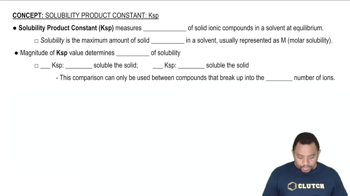
Solubility Product Constant (Ksp)
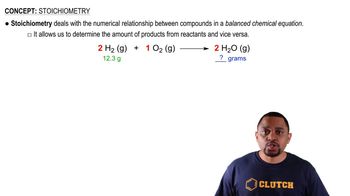
Titration and Stoichiometry
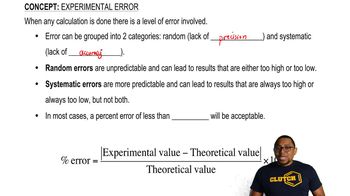
Comparison of Experimental and Literature Values
The value of Ksp for Cd(OH)2 is 2.5 × 10⁻¹⁴. (a) What is the molar solubility of Cd(OH)2?
A concentration of 10–100 parts per billion (by mass) of Ag+ is an effective disinfectant in swimming pools. However, if the concentration exceeds this range, the Ag+ can cause adverse health effects. One way to maintain an appropriate concentration of Ag+ is to add a slightly soluble salt to the pool. Using Ksp values from Appendix D, calculate the equilibrium concentration of Ag+ in parts per billion that would exist in equilibrium with (b) AgBr (c) AgI.
In nonaqueous solvents, it is possible to react HF to create H2F+. Which of these statements follows from this observation? (a) HF can act like a strong acid in nonaqueous solvents, (b) HF can act like a base in nonaqueous solvents, (c) HF is thermodynamically unstable, (d) There is an acid in the nonaqueous medium that is a stronger acid than HF.
(a) Write the net ionic equation for the reaction that occurs when a solution of hydrochloric acid (HCl) is mixed with a solution of sodium formate 1NaCHO22.
