
Textbook Question
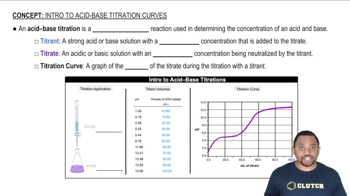
(a) How many milliliters of 0.120 M HCl are needed to completely neutralize 50.0 mL of 0.101 M Ba(OH)2 solution?
981
views

 Verified step by step guidance
 03:04
03:04
 01:13
01:13 01:16
01:16(a) How many milliliters of 0.120 M HCl are needed to completely neutralize 50.0 mL of 0.101 M Ba(OH)2 solution?
A solution of 100.0 mL of 0.200 M KOH is mixed with a solution of 200.0 mL of 0.150 M NiSO4. (a) Write the balanced chemical equation for the reaction that occurs.
(b) How many milliliters of 0.125 M H2SO4 are needed to neutralize 0.200 g of NaOH?
A 4.36-g sample of an unknown alkali metal hydroxide is dissolved in 100.0 mL of water. An acid–base indicator is added, and the resulting solution is titrated with 2.50 M HCl(aq) solution. The indicator changes color, signaling that the equivalence point has been reached, after 17.0 mL of the hydrochloric acid solution has been added. (b) What is the identity of the alkali metal cation: Li+, Na+, K+, Rb+, or Cs+?
A solution of 100.0 mL of 0.200 M KOH is mixed with a solution of 200.0 mL of 0.150 M NiSO4. (b) What precipitate forms?