
When a 5.10-g sample of solid sodium hydroxide dissolves in 100.0 g of water in a coffee-cup calorimeter (Figure 5.18), the temperature rises from 20.5 to 33.2 °C. b. Using your result from part (a), calculate ΔH (in kJ/mol NaOH) for the solution process. Assume that the specific heat of the solution is the same as that of pure water.
Ch.5 - Thermochemistry

Brown15th EditionChemistry: The Central ScienceISBN: 9780137542970Not the one you use?Change textbook
Chapter 5, Problem 54b
Consider the data about gold metal in Exercise 5.24(b). b. Suppose that the same amount of heat is added to two 10.0-g blocks of metal, both initially at the same temperature. One block is gold metal, and the other is iron metal. Which block will have the greater rise in temperature after addition of the heat?
Verified step by step guidance1
Identify the specific heat capacities of gold and iron. The specific heat capacity is the amount of heat required to raise the temperature of 1 gram of a substance by 1 degree Celsius.
Recall that the specific heat capacity of gold is approximately 0.129 J/g°C, and for iron, it is approximately 0.450 J/g°C.
Use the formula for heat transfer: \( q = mc\Delta T \), where \( q \) is the heat added, \( m \) is the mass, \( c \) is the specific heat capacity, and \( \Delta T \) is the change in temperature.
Since the same amount of heat \( q \) is added to both metals and they have the same mass, the change in temperature \( \Delta T \) is inversely proportional to the specific heat capacity \( c \).
Conclude that the metal with the lower specific heat capacity (gold) will experience a greater rise in temperature compared to the metal with the higher specific heat capacity (iron).

Verified video answer for a similar problem:
This video solution was recommended by our tutors as helpful for the problem above.
Video duration:
3mWas this helpful?
Key Concepts
Here are the essential concepts you must grasp in order to answer the question correctly.
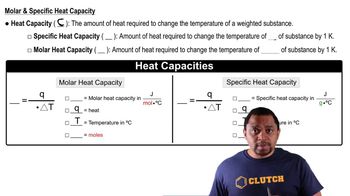
Specific Heat Capacity
Specific heat capacity is the amount of heat required to raise the temperature of a unit mass of a substance by one degree Celsius. Different materials have different specific heat capacities, which means they absorb and retain heat differently. For example, gold has a lower specific heat capacity than iron, meaning it will experience a greater temperature increase when the same amount of heat is added.
Recommended video:
Guided course
Heat Capacity
Heat Transfer
Heat transfer refers to the movement of thermal energy from one object or substance to another. In this scenario, when heat is added to both blocks of metal, the heat will flow into each block, causing their temperatures to rise. The efficiency of this heat transfer is influenced by the specific heat capacity of each material, affecting how much their temperatures increase.
Recommended video:
Guided course
Heat Capacity
Thermal Equilibrium
Thermal equilibrium is the state reached when two objects in contact no longer transfer heat between them, resulting in equal temperatures. In the context of this question, understanding thermal equilibrium helps explain how the temperature of each metal block will change in response to the same amount of heat added, ultimately leading to a comparison of their temperature rises based on their specific heat capacities.
Related Practice
Textbook Question
2
views
Textbook Question
Consider the data about gold metal in Exercise 5.24(b). c. What is the molar heat capacity of Au(s)?
2
views
Textbook Question
When a 5.10-g sample of solid sodium hydroxide dissolves in 100.0 g of water in a coffee-cup calorimeter (Figure 5.18), the temperature rises from 20.5 to 33.2 °C. a. Calculate the quantity of heat (in kJ) released in the reaction.
3
views
Textbook Question
(d) How many kJ of heat are needed to raise the temperature of 10.00 kg of liquid water from 24.6 to 46.2 °C?
2
views
Textbook Question
The specific heat of ethanol, C2H5OH(l), is 2.44 J•g/K. b. Which will require more heat, increasing the temperature of 1 mol of C2H5OH(𝑙) by a certain amount or increasing the temperature of 1 mol of H2O(𝑙) by the same amount?
4
views
Textbook Question
(b) Calculate the energy needed for this temperature change.
1316
views
