
Textbook Question
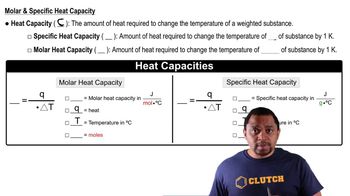
b. What are the units of specific heat?
3
views

 Verified step by step guidance
 02:19
02:19 02:19
02:19 02:13
02:13b. What are the units of specific heat?
Consider the decomposition of liquid benzene, C6H6(l), to gaseous acetylene, C2H2(g): C6H6(l) → 3 C2H2(g) ΔH = +630 kJ (c) Which is more likely to be thermodynamically favored, the forward reaction or the reverse reaction?
Consider the data about gold metal in Exercise 5.24(b). b. Suppose that the same amount of heat is added to two 10.0-g blocks of metal, both initially at the same temperature. One block is gold metal, and the other is iron metal. Which block will have the greater rise in temperature after addition of the heat?
The specific heat of ethanol, C2H5OH(l), is 2.44 J•g/K. b. Which will require more heat, increasing the temperature of 1 mol of C2H5OH(𝑙) by a certain amount or increasing the temperature of 1 mol of H2O(𝑙) by the same amount?
Two solid objects, A and B, are placed in boiling water and allowed to come to the temperature of the water. Each is then lifted out and placed in separate beakers containing 1000 g of water at 10.0 °C. Object A increases the water temperature by 3.50 °C; B increases the water temperature by 2.60 °C. (a) Which object has the larger heat capacity?
(b) Calculate the energy needed for this temperature change.