
Textbook Question
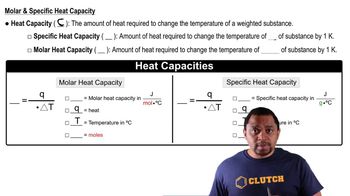
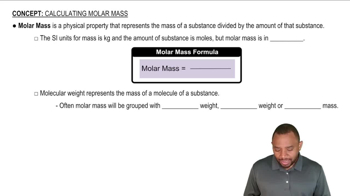
Consider the data about gold metal in Exercise 5.24(b). c. What is the molar heat capacity of Au(s)?
2
views

 Verified step by step guidance
 02:19
02:19
 02:11 02:19
Consider the data about gold metal in Exercise 5.24(b). c. What is the molar heat capacity of Au(s)?
When a 5.10-g sample of solid sodium hydroxide dissolves in 100.0 g of water in a coffee-cup calorimeter (Figure 5.18), the temperature rises from 20.5 to 33.2 °C. a. Calculate the quantity of heat (in kJ) released in the reaction.
(d) How many kJ of heat are needed to raise the temperature of 10.00 kg of liquid water from 24.6 to 46.2 °C?
Consider the data about gold metal in Exercise 5.24(b). b. Suppose that the same amount of heat is added to two 10.0-g blocks of metal, both initially at the same temperature. One block is gold metal, and the other is iron metal. Which block will have the greater rise in temperature after addition of the heat?
Two solid objects, A and B, are placed in boiling water and allowed to come to the temperature of the water. Each is then lifted out and placed in separate beakers containing 1000 g of water at 10.0 °C. Object A increases the water temperature by 3.50 °C; B increases the water temperature by 2.60 °C. (a) Which object has the larger heat capacity?
(b) Calculate the energy needed for this temperature change.