
Textbook Question
b. What are the units of specific heat?
3
views

 Verified step by step guidance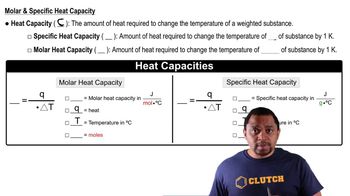
 02:19
02:19 02:19 02:19
b. What are the units of specific heat?
Consider the decomposition of liquid benzene, C6H6(l), to gaseous acetylene, C2H2(g): C6H6(l) → 3 C2H2(g) ΔH = +630 kJ (c) Which is more likely to be thermodynamically favored, the forward reaction or the reverse reaction?
(d) How many kJ of heat are needed to raise the temperature of 10.00 kg of liquid water from 24.6 to 46.2 °C?
The specific heat of ethanol, C2H5OH(l), is 2.44 J•g/K. b. Which will require more heat, increasing the temperature of 1 mol of C2H5OH(𝑙) by a certain amount or increasing the temperature of 1 mol of H2O(𝑙) by the same amount?
Consider the decomposition of liquid benzene, C6H6(l), to gaseous acetylene, C2H2(g): C6H6(l) → 3 C2H2(g) ΔH = +630 kJ (b) What is H for the formation of 1 mol of acetylene?
(b) Calculate the energy needed for this temperature change.