
Ch.1 - Chemical Tools: Experimentation & Measurement
McMurry - Chemistry 8th Edition
McMurry8th EditionChemistryISBN: 9781292336145Not the one you use?Change textbook
Chapter 1, Problem 8

Consider 20 mL samples of the following liquids. Which sample has the largest mass? (LO 1.9) (a) Water (density = 1.0 g/mL) (b) Glycerol (density = 1.26 g/mL) (c) Ethanol (density = 0.79 g/mL) (d) Acetic acid (density = 1.05 g/mL

Verified step by step guidance
1
Identify the formula for mass: \( \text{mass} = \text{density} \times \text{volume} \).
Determine the volume of each liquid sample, which is given as 20 mL for all samples.
Calculate the mass of water using its density: \( \text{mass} = 1.0 \, \text{g/mL} \times 20 \, \text{mL} \).
Calculate the mass of glycerol using its density: \( \text{mass} = 1.26 \, \text{g/mL} \times 20 \, \text{mL} \).
Calculate the mass of ethanol using its density: \( \text{mass} = 0.79 \, \text{g/mL} \times 20 \, \text{mL} \).

Key Concepts

Here are the essential concepts you must grasp in order to answer the question correctly.

Density

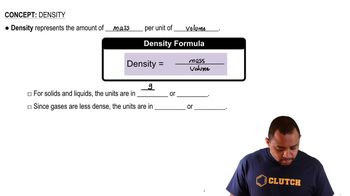
Density is defined as mass per unit volume, typically expressed in grams per milliliter (g/mL). It indicates how much mass is contained in a given volume of a substance. In this question, the densities of the liquids are crucial for determining which sample has the largest mass, as mass can be calculated by multiplying density by volume.
Recommended video:
Guided course
01:56
Density Concepts

Mass Calculation

Mass can be calculated using the formula: mass = density × volume. In this scenario, since all samples have the same volume of 20 mL, the mass of each liquid can be directly compared by multiplying their respective densities by this volume. This calculation allows for a straightforward comparison of the masses of the different liquids.
Recommended video:
Guided course
03:12
Molar Mass Calculation Example

Comparison of Liquids

To determine which liquid has the largest mass, one must compare the calculated masses of each liquid based on their densities. By applying the mass calculation to each option, the liquid with the highest density will yield the greatest mass when the same volume is considered. This comparison is essential for identifying the correct answer to the question.
Recommended video:
Guided course
02:11
Oxyacid Strength Comparison
Related Practice
Textbook Question
A 25.5 g sample of a metal was placed into water in a gradu-ated cylinder. The metal sank to the bottom, and the water level rose from 15.7 mL to 25.3 mL. What is the identity of the metal? (LO 1.9) (a) Tin (density = 7.31 g/cm3) (b) Lead (density = 11.34 g/cm3) (c) Silver (density = 10.49 g/cm3) (d) Aluminum (density = 2.64 g/cm3)
881
views
Textbook Question
Report the reading on the buret to the correct number of significant figures. (LO 1.15) (a) 1 mL (b) 1.4 mL (c) 1.40 mL (d) 1.400 mL
742
views
Textbook Question
Calculate the volume in liters of a rectangular object with dimensions 13.0 cm * 11.0 cm * 12.0 cm. (a) 1720 L (b) 1.72 L (c) 14.3 L (d) 2.41 L
826
views
Textbook Question
A scientist uses an uncalibrated pH meter and measures the pH of a rainwater sample four times. A different pH meter was calibrated using several solutions with known pH. The true pH of the rain was found by the calibrated pH meter to be 5.12. What can be said about the level of accuracy and precision of the uncalibrated pH meter? (LO 1.14)(a) The uncalibrated pH meter is accurate and precise. (b) The uncalibrated pH meter is neither accurate nor precise. (c) The uncalibrated pH meter is accurate but not precise. (d) The uncalibrated pH meter is precise but not accurate.
375
views
Textbook Question

The temperature on the surface of the Sun is 5778 K. What is the temperature in degrees Fahrenheit? (LO 1.6) (d) 9941 °F

505
views
1
rank
Textbook Question
The cylinder contains two liquids that do not mix with one another: water (density = 1.0 g/mL) and vegetable oil (density = 0.93 g/mL). Four different pieces of plastic are added to the cylinder. Which type of plastic is at the position indicated by the square object in the figure? (LO 1.10) (a) Polyvinyl chloride (density = 1.26 g/mL) (b) Polypropylene (density = 0.90 g/mL) (c) High-density polyethylene (density = 0.96 g/mL) (d) Polyethylene terephthalate (density = 1.38 g/mL)

517
views