The cylinder contains two liquids that do not mix with one another: water (density = 1.0 g/mL) and vegetable oil (density = 0.93 g/mL). Four different pieces of plastic are added to the cylinder. Which type of plastic is at the position indicated by the square object in the figure? (LO 1.10) (a) Polyvinyl chloride (density = 1.26 g/mL) (b) Polypropylene (density = 0.90 g/mL) (c) High-density polyethylene (density = 0.96 g/mL) (d) Polyethylene terephthalate (density = 1.38 g/mL)
Verified step by step guidance
1
Identify the densities of the liquids in the cylinder: water (1.0 g/mL) and vegetable oil (0.93 g/mL).
Note the position of the square object in the figure. It is floating at the interface between the water and vegetable oil layers.
Determine the density of the object based on its position. Since it is floating at the interface, its density must be between the densities of water and vegetable oil.
Compare the densities of the given plastics: Polyvinyl chloride (1.26 g/mL), Polypropylene (0.90 g/mL), High-density polyethylene (0.96 g/mL), and Polyethylene terephthalate (1.38 g/mL).
Identify the plastic with a density between 0.93 g/mL and 1.0 g/mL, which corresponds to the position of the square object in the figure.
Verified video answer for a similar problem:
This video solution was recommended by our tutors as helpful for the problem above.
Video duration:
2m
Play a video:
0 Comments
Was this helpful?
Key Concepts
Here are the essential concepts you must grasp in order to answer the question correctly.
Density
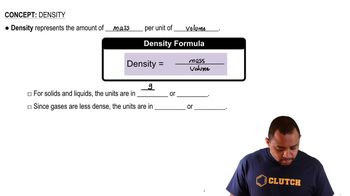
Density is defined as mass per unit volume and is a key property of substances that determines whether they will float or sink in a fluid. In this scenario, the densities of the liquids (water and vegetable oil) and the plastics are crucial for predicting the behavior of the plastic pieces when placed in the cylinder. An object will float in a fluid if its density is less than that of the fluid and sink if its density is greater.
Buoyancy is the upward force exerted by a fluid that opposes the weight of an object immersed in it. This concept is essential for understanding why certain plastics will either float on the surface of the water or sink to the bottom of the cylinder. The position of the plastic piece in the cylinder will depend on the relative densities of the plastic and the two liquids.
Immiscibility
Immiscibility refers to the inability of two substances to mix or form a homogeneous solution. In this case, water and vegetable oil are immiscible, leading to the formation of distinct layers in the cylinder. This property affects how the plastics interact with the liquids, as their placement will be influenced by their densities relative to both the water and the oil.



 Verified step by step guidance
 01:56
01:56