
Consider the titration of 50.0 mL of a 0.100 M solution of the protonated form of the amino acid alanine (H2A+: Ka1 = 4.6 × 10⁻³, Ka2 = 2.0 × 10⁻¹⁰) with 0.100 M NaOH. Calculate the pH after the addition of each of the following volumes of base. (e) 100.0 mL
Ch.17 - Applications of Aqueous Equilibria
Chapter 17, Problem 97a,c
Consider the titration of 50.0 mL of 1.00 M H3PO4 with 1.00 M KOH. Calculate the pH after the addition of each of the following volumes of base. (a) 25.0 mL (c) 75.0 mL
Verified step by step guidance1
Identify the reaction between H3PO4 (phosphoric acid) and KOH (potassium hydroxide). The reaction is H3PO4 + KOH
ightarrow KH2PO4 + H2O, where H3PO4 loses one proton to form KH2PO4.
Calculate the initial moles of H3PO4 and KOH. Since the concentration of H3PO4 is 1.00 M and the volume is 50.0 mL, the moles of H3PO4 are 0.0500 mol. For KOH, with 25.0 mL at 1.00 M, the moles are 0.0250 mol.
Determine the limiting reactant. In this case, KOH is the limiting reactant because there are fewer moles of KOH than H3PO4.
Calculate the moles of H3PO4 remaining after the reaction. Subtract the moles of KOH from the moles of H3PO4 to find the moles of unreacted H3PO4, which will be 0.0250 mol.
Calculate the concentration of the remaining H3PO4 and the formed KH2PO4 in the solution. The total volume of the solution after adding KOH is 75.0 mL. Use this volume to find the concentrations and then use the dissociation constant (Ka) of H3PO4 to find the pH of the solution.

Verified video answer for a similar problem:
This video solution was recommended by our tutors as helpful for the problem above.
Video duration:
6mWas this helpful?
Key Concepts
Here are the essential concepts you must grasp in order to answer the question correctly.
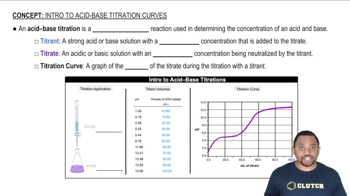
Titration
Titration is a quantitative analytical technique used to determine the concentration of a solute in a solution. It involves the gradual addition of a titrant (in this case, KOH) to a solution of analyte (H3PO4) until the reaction reaches its equivalence point, where stoichiometrically equivalent amounts of acid and base have reacted. The pH changes during this process can be monitored to determine the endpoint.
Recommended video:
Guided course
Acid-Base Titration
Acid-Base Neutralization
Acid-base neutralization is a chemical reaction between an acid and a base that produces water and a salt. In this titration, H3PO4, a triprotic acid, reacts with KOH, a strong base. The reaction can be represented as H3PO4 + KOH → K2H2PO4 + H2O, and understanding the stoichiometry of this reaction is crucial for calculating the resulting pH after specific volumes of KOH are added.
Recommended video:
Guided course
Lewis Acids and Bases
pH Calculation
pH is a measure of the acidity or basicity of a solution, defined as the negative logarithm of the hydrogen ion concentration (pH = -log[H+]). In titrations, the pH can change significantly depending on the amount of acid and base present. After adding a specific volume of KOH, the pH can be calculated using the concentrations of the remaining acid and the produced salt, as well as the dissociation of water, especially near the equivalence point.
Recommended video:
Guided course
pH Calculation Example
Related Practice
Textbook Question
486
views
Textbook Question
Consider the titration of 50.0 mL of a 0.100 M solution of the protonated form of the amino acid alanine (H2A+: Ka1 = 4.6 × 10⁻³, Ka2 = 2.0 × 10⁻¹⁰) with 0.100 M NaOH. Calculate the pH after the addition of each of the following volumes of base. (b) 25.0 mL (c) 50.0 mL
Textbook Question
The titration of 0.02500 L of a diprotic acid solution with 0.1000 M NaOH requires 34.72 mL of titrant to reach the second equivalence point. The pH is 3.95 at the first equiva-lence point and 9.27 at the second equivalence point. If the acid solution contained 0.2015 g of the acid, what is the molar mass, pKa1, and pKa2 of the acid?
853
views
Textbook Question
Consider the titration of 50.0 mL of a 0.100 M solution of the protonated form of the amino acid alanine (H2A+: Ka1 = 4.6 × 10⁻³, Ka2 = 2.0 × 10⁻¹⁰) with 0.100 M NaOH. Calculate the pH after the addition of each of the following volumes of base. (d) 75.0 mL
911
views
Textbook Question
For each of the following compounds, write a balanced net ionic equation for the dissolution of the compound in water, and write the equilibrium-constant expression for Ksp. (d) Hg2Cl2
449
views
