
Consider the titration of 50.0 mL of a 0.100 M solution of the protonated form of the amino acid alanine (H2A+: Ka1 = 4.6 × 10⁻³, Ka2 = 2.0 × 10⁻¹⁰) with 0.100 M NaOH. Calculate the pH after the addition of each of the following volumes of base. (a) 10.0 mL
Ch.17 - Applications of Aqueous Equilibria
Chapter 17, Problem 95e
Consider the titration of 50.0 mL of a 0.100 M solution of the protonated form of the amino acid alanine (H2A+: Ka1 = 4.6 × 10⁻³, Ka2 = 2.0 × 10⁻¹⁰) with 0.100 M NaOH. Calculate the pH after the addition of each of the following volumes of base. (e) 100.0 mL
Verified step by step guidance1
Determine the initial moles of H2A+ in the solution using the formula: \( \text{moles} = \text{volume} \times \text{concentration} \).
Calculate the moles of NaOH added using the same formula: \( \text{moles} = \text{volume} \times \text{concentration} \).
Since 100.0 mL of NaOH is added, which is twice the initial volume of H2A+, determine the limiting reactant and the remaining species after the reaction.
Recognize that at this point, all H2A+ has been converted to A- (the fully deprotonated form), and the solution contains excess NaOH.
Calculate the pH of the solution by determining the concentration of OH- from the excess NaOH and using the relation \( \text{pH} = 14 - \text{pOH} \).

Verified video answer for a similar problem:
This video solution was recommended by our tutors as helpful for the problem above.
Video duration:
8mWas this helpful?
Key Concepts
Here are the essential concepts you must grasp in order to answer the question correctly.
Titration
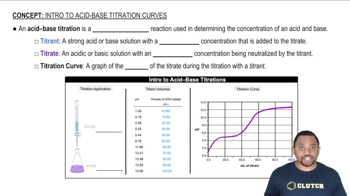
Titration is a quantitative analytical technique used to determine the concentration of a solute in a solution. It involves the gradual addition of a titrant (in this case, NaOH) to a solution containing the analyte (the protonated form of alanine) until the reaction reaches its equivalence point. The pH changes during this process, and understanding how to calculate the pH at various points is crucial for interpreting titration results.
Recommended video:
Guided course
Acid-Base Titration
Acid-Base Equilibria
Acid-base equilibria involve the dissociation of acids and bases in solution, characterized by their acid dissociation constants (Ka). For alanine, the two dissociation constants (Ka1 and Ka2) indicate the strength of the acid in its protonated forms. Understanding these constants helps predict the pH of the solution at different stages of titration, particularly when calculating the pH after adding a specific volume of base.
Recommended video:
Guided course
Arrhenius Acids and Bases
Buffer Solutions
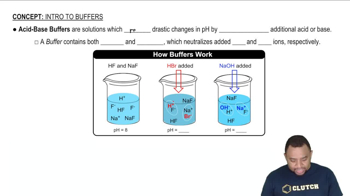
Buffer solutions resist changes in pH upon the addition of small amounts of acid or base. In the context of the titration of alanine, the solution can act as a buffer before reaching the equivalence point, where both the protonated and deprotonated forms of the amino acid are present. Recognizing the buffer region and its capacity is essential for accurately calculating the pH after the addition of NaOH.
Recommended video:
Guided course
Buffer Solutions
Related Practice
Textbook Question
889
views
Textbook Question
Consider the titration of 50.0 mL of a 0.100 M solution of the protonated form of the amino acid alanine (H2A+: Ka1 = 4.6 × 10⁻³, Ka2 = 2.0 × 10⁻¹⁰) with 0.100 M NaOH. Calculate the pH after the addition of each of the following volumes of base. (b) 25.0 mL (c) 50.0 mL
Textbook Question
The titration of 0.02500 L of a diprotic acid solution with 0.1000 M NaOH requires 34.72 mL of titrant to reach the second equivalence point. The pH is 3.95 at the first equiva-lence point and 9.27 at the second equivalence point. If the acid solution contained 0.2015 g of the acid, what is the molar mass, pKa1, and pKa2 of the acid?
853
views
Textbook Question
Consider the titration of 50.0 mL of a 0.100 M solution of the protonated form of the amino acid alanine (H2A+: Ka1 = 4.6 × 10⁻³, Ka2 = 2.0 × 10⁻¹⁰) with 0.100 M NaOH. Calculate the pH after the addition of each of the following volumes of base. (d) 75.0 mL
911
views
Textbook Question
Consider the titration of 50.0 mL of 1.00 M H3PO4 with 1.00 M KOH. Calculate the pH after the addition of each of the following volumes of base. (a) 25.0 mL (c) 75.0 mL
286
views
Textbook Question
For each of the following compounds, write a balanced net ionic equation for the dissolution of the compound in water, and write the equilibrium-constant expression for Ksp. (d) Hg2Cl2
449
views
