Ch.18 - Thermodynamics: Entropy, Free Energy & Equilibrium
McMurry - Chemistry 8th Edition
McMurry8th EditionChemistryISBN: 9781292336145Not the one you use?Change textbook
Chapter 18, Problem 132

Tell whether reactions with the following values of ΔH and ΔS are spontaneous or nonspontaneous and whether they are exothermic or endothermic. (a) ΔH = - 48 kJ; ΔS = + 135 J>K at 400 K (b) ΔH = - 48 kJ; ΔS = - 135 J>K at 400 K (c) ΔH = + 48 kJ; ΔS = + 135 J>K at 400 K (d) ΔH = + 48 kJ; ΔS = - 135 J>K at 400 K

Verified step by step guidance
1
Step 1: Recall the Gibbs free energy equation: \( \Delta G = \Delta H - T \Delta S \). This equation helps determine the spontaneity of a reaction.
Step 2: Convert \( \Delta S \) from J/K to kJ/K by dividing by 1000, since \( \Delta H \) is given in kJ.
Step 3: For each scenario, substitute the given values of \( \Delta H \), \( \Delta S \), and \( T \) into the Gibbs free energy equation to calculate \( \Delta G \).
Step 4: Determine spontaneity: If \( \Delta G < 0 \), the reaction is spontaneous; if \( \Delta G > 0 \), the reaction is nonspontaneous.
Step 5: Determine if the reaction is exothermic or endothermic: If \( \Delta H < 0 \), the reaction is exothermic; if \( \Delta H > 0 \), the reaction is endothermic.

Verified video answer for a similar problem:

This video solution was recommended by our tutors as helpful for the problem above.
Video duration:
8m
Was this helpful?

Key Concepts

Here are the essential concepts you must grasp in order to answer the question correctly.

Gibbs Free Energy

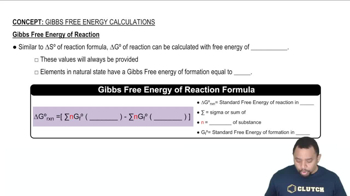
Gibbs Free Energy (G) is a thermodynamic potential that helps predict the spontaneity of a reaction at constant temperature and pressure. The change in Gibbs Free Energy (ΔG) is calculated using the equation ΔG = ΔH - TΔS, where ΔH is the change in enthalpy, T is the temperature in Kelvin, and ΔS is the change in entropy. A negative ΔG indicates a spontaneous reaction, while a positive ΔG indicates nonspontaneity.
Recommended video:
Guided course
01:51
Gibbs Free Energy of Reactions

Enthalpy (ΔH)

Enthalpy (ΔH) is a measure of the total heat content of a system. It can be classified as exothermic (ΔH < 0) when heat is released during a reaction, or endothermic (ΔH > 0) when heat is absorbed. The sign of ΔH is crucial for determining the energy changes associated with a reaction and influences the overall spontaneity when combined with entropy changes.

Entropy (ΔS)

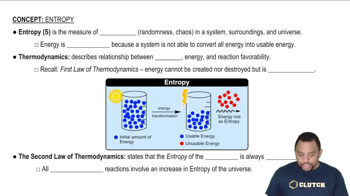
Entropy (ΔS) is a measure of the disorder or randomness in a system. A positive ΔS indicates an increase in disorder, which generally favors spontaneity, while a negative ΔS suggests a decrease in disorder, which can hinder spontaneity. The interplay between ΔS and ΔH at a given temperature is essential for determining whether a reaction will occur spontaneously.
Recommended video:
Guided course
02:46
Entropy in Thermodynamics
Related Practice
Textbook Question

Consider the Haber synthesis of gaseous NH3 (∆H°f = -46.1 kJ/mol; ∆G°f = -16.5 kJ/mol: (d) What are the equilibrium constants Kp and Kc for the reaction at 350 K? Assume that ∆H° and ∆S° are independent of temperature.

489
views

Textbook Question
Is it possible for a reaction to be nonspontaneous yet exo-thermic? Explain.
242
views
Textbook Question

Trouton's rule says that the ratio of the molar heat of vaporization of a liquid to its normal boiling point (in kelvin) is approximately the same for all liquids: ∆Hvap/Tbp ≈ 88 J/(K*mol) (b) Explain why liquids tend to have the same value of ∆Hvap/Tbp.

808
views
Textbook Question
A mixture of 14.0 g of N2 and 3.024 g of H2 in a 5.00 L container is heated to 400 °C. Use the data in Appendix B to calculate the molar concentrations of N2, H2, and NH3 at equilibrium. Assume that ∆H° and ∆S° are independent of temperature, and remember that the standard state of a gas is defined in terms of pressure.

553
views
Textbook Question
Suppose that a reaction has ΔH = - 33 kJ and ΔS = - 58 J>K. At what temperature will it change from spontaneous to nonspontaneous?
494
views
Textbook Question
The following reaction, sometimes used in the laboratory to generate small quantities of oxygen gas, has ∆G° = -224.4 kJ/mol at 25°C:

Use the following additional data at 25 °C to calculate the standard molar entropy S° of O2 at 25°C: ∆H°f(KClO3) = -397.7 kJ/mol, ∆H°f(KCl) = -436.5 kJ/mol, S°(KClO3) = 143.1 J/(K*mol), and S°(KCl) = 82.6 J/(K*mol).
549
views