Ch.18 - Thermodynamics: Entropy, Free Energy & Equilibrium
McMurry - Chemistry 8th Edition
McMurry8th EditionChemistryISBN: 9781292336145Not the one you use?Change textbook
Chapter 18, Problem 133

The following reaction, sometimes used in the laboratory to generate small quantities of oxygen gas, has ∆G° = -224.4 kJ/mol at 25°C: Table showing thermodynamic data for AgBr, including enthalpy and entropy values.
Use the following additional data at 25 °C to calculate the standard molar entropy S° of O2 at 25°C: ∆H°f(KClO3) = -397.7 kJ/mol, ∆H°f(KCl) = -436.5 kJ/mol, S°(KClO3) = 143.1 J/(K*mol), and S°(KCl) = 82.6 J/(K*mol).

Verified step by step guidance
1
Write the balanced chemical equation for the decomposition of KClO3: 2 KClO3(s) → 2 KCl(s) + 3 O2(g).
Use the given standard enthalpies of formation (ΔH°f) to calculate the ΔH° for the reaction: ΔH° = [2ΔH°f(KCl) + 3ΔH°f(O2)] - [2ΔH°f(KClO3)].
Since ΔH°f(O2) = 0 (standard state), substitute the given values: ΔH° = [2(-436.5 kJ/mol) + 3(0)] - [2(-397.7 kJ/mol)].
Use the given standard molar entropies (S°) to calculate the ΔS° for the reaction: ΔS° = [2S°(KCl) + 3S°(O2)] - [2S°(KClO3)].
Rearrange the Gibbs free energy equation ΔG° = ΔH° - TΔS° to solve for S°(O2): S°(O2) = [ΔH° - ΔG°] / T.

Key Concepts

Here are the essential concepts you must grasp in order to answer the question correctly.

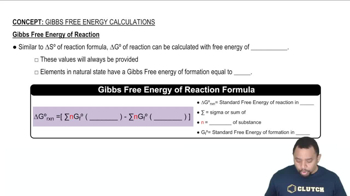
Gibbs Free Energy (∆G°)

Gibbs Free Energy is a thermodynamic potential that measures the maximum reversible work obtainable from a thermodynamic system at constant temperature and pressure. The change in Gibbs Free Energy (∆G°) indicates the spontaneity of a reaction; a negative value (like -224.4 kJ/mol) suggests that the reaction is spontaneous under standard conditions.
Recommended video:
Guided course
01:51
Gibbs Free Energy of Reactions

Standard Molar Entropy (S°)

Standard molar entropy is a measure of the disorder or randomness of a system at standard conditions (1 bar, 25°C). It is expressed in units of J/(K·mol). The entropy values of reactants and products are crucial for calculating the overall entropy change in a reaction, which can help determine the feasibility of the reaction.

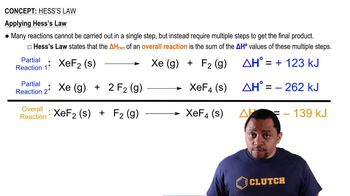
Hess's Law

Hess's Law states that the total enthalpy change for a reaction is the same, regardless of the number of steps taken to complete the reaction. This principle allows for the calculation of enthalpy changes using known enthalpy values of formation and can be applied to derive the standard molar entropy of a substance by combining the enthalpy and entropy data of the involved species.
Recommended video: