Ch.19 - Electrochemistry
McMurry - Chemistry 8th Edition
McMurry8th EditionChemistryISBN: 9781292336145Not the one you use?Change textbook
Chapter 19, Problem 140

How many hours are required to produce 1.00 * 103 kg of sodium by the electrolysis of molten NaCl with a constant current of 3.00 * 104 A? How many liters of Cl2 at STP will be obtained as a by-product?

Verified step by step guidance
1
Identify the chemical reaction involved in the electrolysis of molten NaCl: \(2\text{NaCl} \rightarrow 2\text{Na} + \text{Cl}_2\).
Calculate the moles of sodium (Na) to be produced using its molar mass: \(\text{moles of Na} = \frac{\text{mass of Na}}{\text{molar mass of Na}}\).
Determine the moles of electrons required using the stoichiometry of the reaction: 2 moles of electrons are needed to produce 2 moles of Na.
Use Faraday's law of electrolysis to find the total charge required: \(Q = n \times F\), where \(n\) is the moles of electrons and \(F\) is Faraday's constant (96485 C/mol).
Calculate the time in seconds using the formula \(t = \frac{Q}{I}\), where \(I\) is the current, and then convert the time from seconds to hours.

Verified video answer for a similar problem:

This video solution was recommended by our tutors as helpful for the problem above.
Video duration:
6m
Was this helpful?

Key Concepts

Here are the essential concepts you must grasp in order to answer the question correctly.

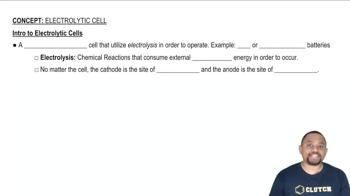
Electrolysis

Electrolysis is a chemical process that uses electrical energy to drive a non-spontaneous reaction. In the case of molten NaCl, electrolysis separates sodium ions (Na+) and chloride ions (Cl-) at the anode and cathode, respectively. This process is essential for producing sodium metal and chlorine gas from sodium chloride.
Recommended video:
Guided course
01:21
The Electrolytic Cell

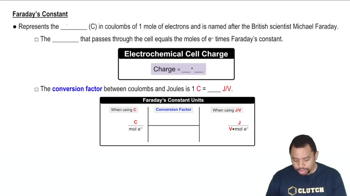
Faraday's Laws of Electrolysis

Faraday's Laws of Electrolysis quantify the relationship between the amount of substance produced at an electrode and the electric charge passed through the electrolyte. The first law states that the mass of a substance produced is directly proportional to the electric charge. This principle is crucial for calculating the time required for electrolysis based on current and the amount of sodium desired.
Recommended video:
Guided course
01:40
Faraday's Constant in Electrochemistry

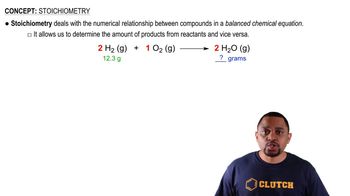
Stoichiometry of Gases

Stoichiometry of gases involves the relationships between the volumes of gases and the amounts of substances in a chemical reaction, particularly under standard temperature and pressure (STP). At STP, one mole of any gas occupies 22.4 liters. This concept is vital for determining the volume of chlorine gas produced as a by-product during the electrolysis of NaCl.
Recommended video:
Guided course
01:16
Stoichiometry Concept