Ch.19 - Electrochemistry
McMurry - Chemistry 8th Edition
McMurry8th EditionChemistryISBN: 9781292336145Not the one you use?Change textbook
Chapter 19, Problem 141

What constant current (in amperes) is required to produce aluminum by the Hall–Héroult process at a rate of 40.0 kg/h?

Verified step by step guidance
1
Identify the chemical reaction involved in the Hall–Héroult process: \(2\text{Al}_2\text{O}_3 + 3\text{C} \rightarrow 4\text{Al} + 3\text{CO}_2\).
Determine the molar mass of aluminum (Al), which is approximately 26.98 g/mol.
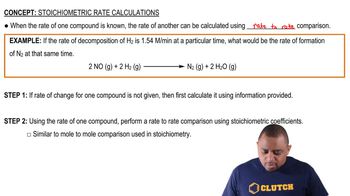
Convert the production rate of aluminum from kg/h to moles per second: \(40.0 \text{ kg/h} \rightarrow \text{g/s} \rightarrow \text{mol/s}\).
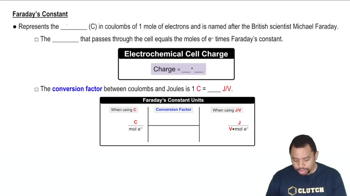
Use Faraday's laws of electrolysis to relate the moles of aluminum produced to the charge required: \(n = \frac{Q}{zF}\), where \(n\) is moles of electrons, \(Q\) is charge in coulombs, \(z\) is the number of electrons transferred per mole of aluminum (3 for Al), and \(F\) is Faraday's constant (96485 C/mol).
Calculate the current \(I\) using the formula \(I = \frac{Q}{t}\), where \(t\) is time in seconds.

Key Concepts

Here are the essential concepts you must grasp in order to answer the question correctly.

Hall–Héroult Process

The Hall–Héroult process is an industrial method for extracting aluminum from its ore, bauxite. It involves the electrolysis of aluminum oxide dissolved in molten cryolite, where aluminum ions are reduced to form aluminum metal at the cathode. Understanding this process is crucial for calculating the current required, as it directly relates to the amount of aluminum produced and the efficiency of the electrolysis.

Faraday's Laws of Electrolysis

Faraday's Laws of Electrolysis describe the relationship between the amount of substance produced at an electrode during electrolysis and the quantity of electric charge passed through the electrolyte. The first law states that the mass of a substance altered at an electrode is proportional to the total electric charge passed. This principle is essential for determining the current needed to produce a specific mass of aluminum in the Hall–Héroult process.
Recommended video:
Guided course
01:40
Faraday's Constant in Electrochemistry

Current Calculation

To calculate the current required for electrolysis, one must consider the molar mass of aluminum and the charge needed to reduce aluminum ions. The formula I = (n * F) / t relates current (I) to the number of moles (n), Faraday's constant (F), and time (t). This calculation is vital for determining the amperage necessary to achieve the desired production rate of aluminum, ensuring efficient operation of the electrolysis process.
Recommended video:
Guided course
02:28
Stoichiometric Rate Calculations