Ch.19 - Electrochemistry
McMurry - Chemistry 8th Edition
McMurry8th EditionChemistryISBN: 9781292336145Not the one you use?Change textbook
Chapter 19, Problem 146c

In order to charge a lead storage battery (Section 19.10) 500.0 g of PbSO4(s) must be converted into PbO2(s) and Pb(s). (c) If a current of 500 A is used, how long will it take?

Verified step by step guidance
1
First, write the balanced chemical equation for the conversion of PbSO4(s) to PbO2(s) and Pb(s). The overall reaction involves the reduction of PbSO4 to Pb and the oxidation of PbSO4 to PbO2.
Calculate the molar mass of PbSO4 using the atomic masses of lead (Pb), sulfur (S), and oxygen (O). This will help in determining the number of moles of PbSO4 present in 500.0 g.
Determine the number of moles of electrons required for the conversion. For each mole of PbSO4, two moles of electrons are needed: one for the reduction to Pb and one for the oxidation to PbO2.
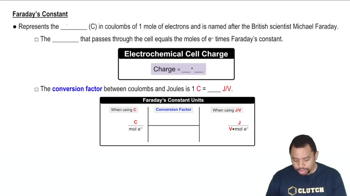
Use Faraday's law of electrolysis, which states that the amount of substance transformed in an electrochemical reaction is directly proportional to the quantity of electricity (in coulombs) passed through the substance. The formula is: \( Q = n \times F \), where \( Q \) is the total charge in coulombs, \( n \) is the number of moles of electrons, and \( F \) is Faraday's constant (approximately 96485 C/mol).
Finally, calculate the time required using the formula \( t = \frac{Q}{I} \), where \( t \) is the time in seconds, \( Q \) is the total charge calculated in the previous step, and \( I \) is the current in amperes (500 A in this case).

Verified video answer for a similar problem:

This video solution was recommended by our tutors as helpful for the problem above.
Video duration:
7m
Was this helpful?

Key Concepts

Here are the essential concepts you must grasp in order to answer the question correctly.

Electrochemical Reactions

Electrochemical reactions involve the transfer of electrons between chemical species, typically occurring in an electrochemical cell. In the context of a lead storage battery, the conversion of PbSO4 to PbO2 and Pb involves oxidation and reduction processes, where lead ions undergo changes in oxidation states. Understanding these reactions is crucial for calculating the amount of charge transferred during the charging process.

Faraday's Laws of Electrolysis

Faraday's laws of electrolysis relate the amount of substance transformed at an electrode to the quantity of electric charge passed through the cell. The first law states that the mass of a substance altered at an electrode is proportional to the total electric charge. This principle is essential for determining how long it will take to convert a specific mass of PbSO4 into PbO2 and Pb, given a constant current.
Recommended video:
Guided course
01:40
Faraday's Constant in Electrochemistry

Current and Time Relationship

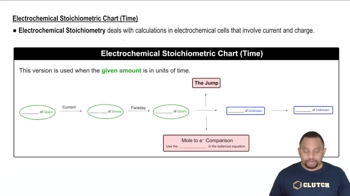
The relationship between current (I), charge (Q), and time (t) is described by the equation Q = I × t. This relationship allows us to calculate the time required for a specific charge to flow through the circuit. In this scenario, knowing the current (500 A) and the total charge needed to convert the lead sulfate is necessary to determine how long the charging process will take.
Recommended video:
Guided course
02:16
Electrochemical Stoichiometric Chart (Time)