Ch.19 - Electrochemistry
McMurry - Chemistry 8th Edition
McMurry8th EditionChemistryISBN: 9781292336145Not the one you use?Change textbook
Chapter 19, Problem 146b

In order to charge a lead storage battery (Section 19.10) 500.0 g of PbSO4(s) must be converted into PbO2(s) and Pb(s). (b) How many coulombs of electrical charge are needed?

Verified step by step guidance
1
Identify the balanced chemical reaction for the conversion of PbSO_4(s) to PbO_2(s) and Pb(s).
Determine the molar mass of PbSO_4 to convert the given mass (500.0 g) into moles.
Use stoichiometry to find the moles of electrons required for the conversion based on the balanced equation.
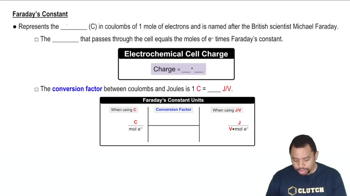
Calculate the total charge in coulombs using the relationship between moles of electrons and charge (1 mole of electrons = 96485 C).
Summarize the steps to ensure all conversions and calculations align with the stoichiometry of the reaction.

Verified video answer for a similar problem:

This video solution was recommended by our tutors as helpful for the problem above.
Video duration:
4m
Was this helpful?

Key Concepts

Here are the essential concepts you must grasp in order to answer the question correctly.

Electrochemical Reactions

Electrochemical reactions involve the transfer of electrons between chemical species, which is fundamental in processes like charging a battery. In a lead storage battery, lead sulfate (PbSO4) is converted into lead dioxide (PbO2) and lead (Pb) through oxidation and reduction reactions, releasing or consuming electrons in the process.

Faraday's Laws of Electrolysis

Faraday's Laws of Electrolysis quantify the relationship between the amount of substance transformed at an electrode and the quantity of electric charge passed through the electrolyte. The first law states that the mass of a substance altered at an electrode is directly proportional to the total electric charge passed, which is crucial for calculating the charge needed to convert PbSO4 to PbO2 and Pb.
Recommended video:
Guided course
01:40
Faraday's Constant in Electrochemistry

Coulombs and Charge Calculation

Coulombs (C) are the standard unit of electric charge in the International System of Units (SI). To determine the total charge required for the conversion of PbSO4 to PbO2 and Pb, one must calculate the moles of electrons involved in the reaction and then use Faraday's constant (approximately 96485 C/mol) to convert moles of electrons to coulombs.
Recommended video:
Guided course
01:15
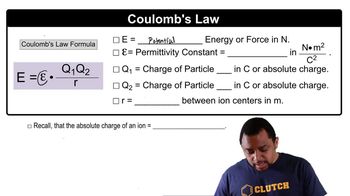
Coulomb's Law Concept 2