Ch.2 - Atoms, Molecules & Ions
McMurry - Chemistry 8th Edition
McMurry8th EditionChemistryISBN: 9781292336145Not the one you use?Change textbook
Chapter 2, Problem 9

How many atoms are present in 1.2 g of gold? (LO 2.16)(a) 2.5 * 1021 (b) 1.4 * 1026 (c) 7.2 * 1023 (d) 3.7 * 1021

Verified step by step guidance
1
Determine the molar mass of gold (Au) from the periodic table, which is approximately 197 g/mol.
Use the formula: number of moles = mass (g) / molar mass (g/mol) to calculate the number of moles of gold in 1.2 g.
Apply Avogadro's number (6.022 x 10^23 atoms/mol) to convert the number of moles of gold to the number of atoms.
Multiply the number of moles obtained in step 2 by Avogadro's number to find the total number of atoms.
Compare the calculated number of atoms with the given options to determine the correct answer.

Verified video answer for a similar problem:

This video solution was recommended by our tutors as helpful for the problem above.
Video duration:
2m
Was this helpful?

Key Concepts

Here are the essential concepts you must grasp in order to answer the question correctly.

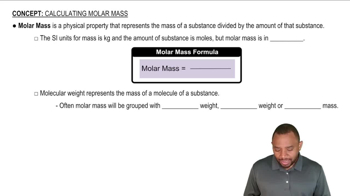
Molar Mass

Molar mass is the mass of one mole of a substance, typically expressed in grams per mole (g/mol). For gold (Au), the molar mass is approximately 197 g/mol. This value is essential for converting grams of a substance to moles, which is a necessary step in determining the number of atoms present in a given mass.
Recommended video:
Guided course
02:11
Molar Mass Concept

Avogadro's Number

Avogadro's number, approximately 6.022 x 10^23, is the number of atoms, ions, or molecules in one mole of a substance. This constant allows chemists to relate the macroscopic scale of substances (grams) to the microscopic scale (number of atoms). It is crucial for calculating the total number of atoms from the number of moles.

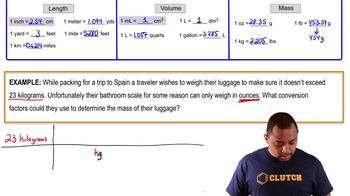
Conversion from Grams to Atoms

To find the number of atoms in a given mass of a substance, one must first convert grams to moles using the molar mass, and then multiply the number of moles by Avogadro's number. This two-step conversion is fundamental in stoichiometry and allows for the quantification of atoms in a sample.
Recommended video:
Guided course
03:45
Weight Conversion Example
Related Practice
Textbook Question
Which sample has the greatest mass? (LO 2.16)(a) 5.5 mol of C (b) 2.1 mol of S (c) 4.2 mol of Be (d) 0.52 mol of Ag
1030
views
1
rank

Textbook Question
How many protons, neutrons, and electrons are in 107Ag+? (LO 2.21)(a) protons = 47, neutrons = 60, electrons = 46 (b) protons = 47, neutrons = 107, electrons = 48 (c) protons = 60, neutrons = 47, electrons = 47 (d) protons = 47, neutrons = 107, electrons = 46
1027
views
1
rank
Textbook Question
Which experiment and subsequent observation led to the discovery that atoms contain negatively charged particles, now known as electrons? (LO 2.10–2.12)(a) Oil is sprayed into a chamber and the speed at which the oil droplets fall is measured with and without an applied voltage. X rays in the chamber knock electrons out of air molecules. The electrons stick to the oil pro-ducing an overall negative charge on the drops. Adjusting the voltage changes the speed at which the negatively charged oil droplets fall. (b) When a high voltage is applied across metal electrodes at opposite ends of a sealed glass tube, a cathode ray is produced. The cathode ray is repelled by a negatively charged plate. (c) A radioactive substance emits alpha particles, which are directed at a thin gold foil. Most of the alpha par-ticles pass through the foil, but a few alpha particles are slightly deflected and some even bounce back toward the radioactive source. (d) The mass of different elements in a pure chemical com-pound are measured. Different samples of the compound always contains the same proportion of elements by mass.
451
views
Textbook Question

Bromine has two naturally occurring isotopes; 79Br (mass of 78.918) and 81Br (mass of 80.916). If the atomic weight of bromine is 79.904, predict the mass spectrum of a sample of bromine atoms. (LO 2.17) (a)

(b)

(c)

(d)

540
views
Textbook Question
A compound containing sulfur and fluorine contains 8.00 g of S and 9.50 g of F. Which combination of S and F masses represents a different compound that obeys the Law of Mul-tiple Proportions? (LO 2.8) (a) 32.0 g of S and 38.0 g of F (b) 4.00 g of S and 4.75 g of F (c) 8.00 g of S and 10.5 g of F (d) 16.0 g of S and 57.0 g of F
710
views
Textbook Question

The molecular illustration represents (LO 2.18) (a) a pure element (b) a mixture of two elements (c) a pure compound (d) a mixture of an element and a compound

542
views