Ch.2 - Atoms, Molecules & Ions
McMurry - Chemistry 8th Edition
McMurry8th EditionChemistryISBN: 9781292336145Not the one you use?Change textbook
Chapter 2, Problem 1

Refer to a periodic table. Which pair of elements do you expect to be most similar in their chemical properties? (LO 2.3) (a) K and Cu(b) O and Se (c) Be and B(d) Rb and Sr

Verified step by step guidance
1
Step 1: Understand the concept of chemical properties similarity. Elements in the same group (column) of the periodic table have similar chemical properties because they have the same number of valence electrons.
Step 2: Identify the group for each element in the options.
Step 3: For option (a), K (Potassium) is in Group 1, and Cu (Copper) is in Group 11.
Step 4: For option (b), O (Oxygen) is in Group 16, and Se (Selenium) is also in Group 16.
Step 5: For option (c), Be (Beryllium) is in Group 2, and B (Boron) is in Group 13. For option (d), Rb (Rubidium) is in Group 1, and Sr (Strontium) is in Group 2.

Verified video answer for a similar problem:

This video solution was recommended by our tutors as helpful for the problem above.
Video duration:
4m
Was this helpful?

Key Concepts

Here are the essential concepts you must grasp in order to answer the question correctly.

Periodic Trends

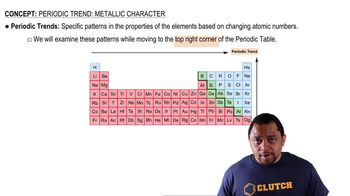
Periodic trends refer to the predictable patterns in the properties of elements as you move across or down the periodic table. These trends include atomic radius, ionization energy, and electronegativity, which influence how elements interact chemically. Understanding these trends helps in predicting the behavior of elements and their similarities.
Recommended video:
Guided course
00:38
Periodic Trends

Group and Period Similarities

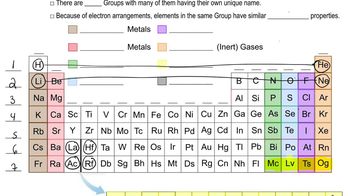
Elements in the same group (column) of the periodic table share similar chemical properties due to having the same number of valence electrons. This similarity affects their reactivity and the types of bonds they form. In contrast, elements in the same period (row) may have different properties as they have different valence electron configurations.
Recommended video:
Guided course
05:33
Periodic Table: Group Names

Metallic vs. Nonmetallic Properties

The distinction between metals and nonmetals is crucial for understanding chemical properties. Metals, typically found on the left side of the periodic table, are good conductors of heat and electricity and tend to lose electrons during reactions. Nonmetals, located on the right, are more likely to gain electrons. Recognizing these differences aids in predicting how elements will behave in chemical reactions.
Related Practice
Textbook Question
Which sample has the greatest mass? (LO 2.16)(a) 5.5 mol of C (b) 2.1 mol of S (c) 4.2 mol of Be (d) 0.52 mol of Ag
1030
views
1
rank
Textbook Question
Which experiment and subsequent observation led to the discovery that atoms contain negatively charged particles, now known as electrons? (LO 2.10–2.12)(a) Oil is sprayed into a chamber and the speed at which the oil droplets fall is measured with and without an applied voltage. X rays in the chamber knock electrons out of air molecules. The electrons stick to the oil pro-ducing an overall negative charge on the drops. Adjusting the voltage changes the speed at which the negatively charged oil droplets fall. (b) When a high voltage is applied across metal electrodes at opposite ends of a sealed glass tube, a cathode ray is produced. The cathode ray is repelled by a negatively charged plate. (c) A radioactive substance emits alpha particles, which are directed at a thin gold foil. Most of the alpha par-ticles pass through the foil, but a few alpha particles are slightly deflected and some even bounce back toward the radioactive source. (d) The mass of different elements in a pure chemical com-pound are measured. Different samples of the compound always contains the same proportion of elements by mass.
451
views
Textbook Question
A compound containing sulfur and fluorine contains 8.00 g of S and 9.50 g of F. Which combination of S and F masses represents a different compound that obeys the Law of Mul-tiple Proportions? (LO 2.8) (a) 32.0 g of S and 38.0 g of F (b) 4.00 g of S and 4.75 g of F (c) 8.00 g of S and 10.5 g of F (d) 16.0 g of S and 57.0 g of F
710
views