Textbook Question
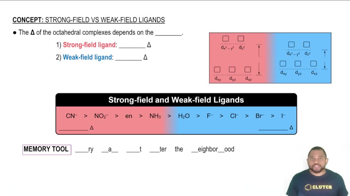
The [Cr(H2O)6]3+ ion is violet, and [Cr(CN)6]3- is yellow. Explain this difference using crystal field theory. Use the colors to order H2O and CN- in the spectrochemical series.
137
views

 McMurry 8th EditionCh.21 - Transition Elements and Coordination ChemistryProblem 21.122
 Verified step by step guidance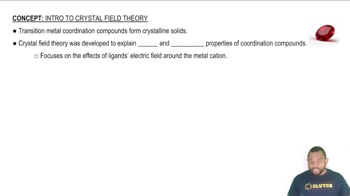
 01:18
01:18
 02:40
02:40 02:40
02:40The [Cr(H2O)6]3+ ion is violet, and [Cr(CN)6]3- is yellow. Explain this difference using crystal field theory. Use the colors to order H2O and CN- in the spectrochemical series.
What is the electron configuration of Co2+ and how many unpaired electrons are in the free transition metal ion?
(a) [Ar]3d54s2; 5 unpaired electrons
(b) [Ar]3d54s2; 1 unpaired electron
(c) [Ar]3d7; 3 unpaired electrons
(d) [Ar]3d7; 1 unpaired electron
Explain why [CoCl4]2- (blue) and [Co(H2O)6]2+ (pink) have different colors. Which complex has its absorption bands at longer wavelengths?
What role does EDTA4- play as a trace additive to mayonnaise? Would the glycinate ion (H2NCH2CH2NH2) be an effective substitute for EDTA4-?
The Ni2+(aq) cation is green, but Zn2+(aq) is colorless. Explain.
For each of the following complexes, draw a crystal field energy-level diagram, assign the electrons to orbitals, and predict the number of unpaired electrons.
(d) [Cu(en)2]2+ (square planar)