What is the highest oxidation state for each of the elements from Sc to Zn?
Ch.21 - Transition Elements and Coordination Chemistry
Chapter 21, Problem 21.76
What role does EDTA4- play as a trace additive to mayonnaise? Would the glycinate ion (H2NCH2CH2NH2) be an effective substitute for EDTA4-?
Verified step by step guidance1
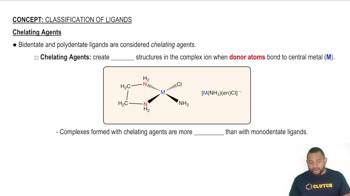
EDTA4- (ethylenediaminetetraacetic acid) is a chelating agent. It binds to metal ions, which prevents them from participating in reactions that could spoil the food. In the case of mayonnaise, EDTA4- binds to metal ions that could catalyze the oxidation of unsaturated fats, leading to rancidity.
The effectiveness of a chelating agent depends on its ability to form stable complexes with metal ions. EDTA4- is a hexadentate ligand, meaning it can form six bonds with a central metal ion. This results in a very stable complex, which is why EDTA4- is such an effective chelating agent.
The glycinate ion (H2NCH2CH2NH2) is a bidentate ligand, meaning it can form two bonds with a central metal ion. While it can act as a chelating agent, it will not form complexes as stable as those formed by EDTA4-.
Therefore, while the glycinate ion could potentially substitute for EDTA4- in mayonnaise, it would not be as effective at preventing spoilage.
Finally, it's important to note that any potential substitute for EDTA4- would also need to be safe for human consumption and not affect the taste or texture of the mayonnaise.

Verified video answer for a similar problem:
This video solution was recommended by our tutors as helpful for the problem above.
Was this helpful?
Key Concepts
Here are the essential concepts you must grasp in order to answer the question correctly.
Chelation
Chelation is a chemical process where a molecule binds to a metal ion, forming a stable complex. EDTA<sup>4-</sup> is a chelating agent that effectively sequesters metal ions, preventing them from catalyzing undesirable reactions in food products like mayonnaise. This helps in preserving the quality and extending the shelf life of the product.
Recommended video:
Guided course
Chelating Agents
Trace Additives
Trace additives are substances added in small amounts to food products to enhance their stability, safety, or nutritional value. In the case of mayonnaise, EDTA<sup>4-</sup> serves as a trace additive to inhibit oxidation and microbial growth by binding metal ions that could promote spoilage. Understanding the role of these additives is crucial for food chemistry.
Glycinate Ion Properties
The glycinate ion (H<sub>2</sub>NCH<sub>2</sub>CH<sub>2</sub>NH<sub>2</sub>) is an amino acid derivative that can also act as a chelating agent, but its effectiveness compared to EDTA<sup>4-</sup> may vary. While glycinate can bind to certain metal ions, it may not form as stable or strong complexes as EDTA<sup>4-</sup>, making it less effective as a substitute in preserving food products like mayonnaise.
Recommended video:
Guided course
Physical Properties
Related Practice
Textbook Question
101
views
Textbook Question
What is the oxidation state of the metal in each of the complexes?
a. AgCl2–
b. [Cr(H2O)5Cl]2+
c. [Co(NCS)4]2–
d. [ZrF8]4–
e. [Fe(EDTA)(H2O)]–
89
views
Textbook Question
The glycinate anion, gly-= NH2CH2CO2 -, bonds to metal ions through the N atom and one of the O atoms. Using to represent gly-, sketch the structures of the four stereoisomers of Co(gly)3.
134
views
Textbook Question
What is the oxidation state of the metal in each of the complexes?
a. [Ni(CN)5]3–
b. Ni(CO)4
c. [Co(en)2(H2O)Br]2+
d. [Cu(H2O)2(C2O4)2]2–
e. Co(NH3)3(NO2)3
72
views
Textbook Question
Which of the following complexes can exist as enantiomers? Draw their structures.
(a) [Cr(en)3]3+
(b) cis-[Co(NH3)Cl]2+
(c) trans-[Co(en)2(NH3)Cl]2+
(d) [Pt(NH3)3Cl3]+
112
views
Textbook Question
Predict the number of unpaired electrons for each of the following.
(a) Sc3+
(b) Co2+
83
views