GeCl4 reacts with Cl- to give GeCl62-, but CCl4 does not react with excess Cl-. Explain.
Ch.22 - The Main Group Elements
Chapter 22, Problem 22.9
Which of the following oxides will be more soluble in acidic solution? (LO 22.14)
(a) SiO2 (b) NO2
(c) BaO (d) B2O3
Verified step by step guidance1
Identify the nature of each oxide: acidic, basic, or amphoteric.
Recall that basic oxides are more soluble in acidic solutions due to acid-base reactions.
Determine the nature of each oxide: SiO2 is acidic, NO2 is acidic, BaO is basic, and B2O3 is acidic.
Recognize that BaO, being a basic oxide, will react with an acidic solution to form a salt and water.
Conclude that BaO will be more soluble in an acidic solution compared to the other oxides.

Verified video answer for a similar problem:
This video solution was recommended by our tutors as helpful for the problem above.
Was this helpful?
Key Concepts
Here are the essential concepts you must grasp in order to answer the question correctly.
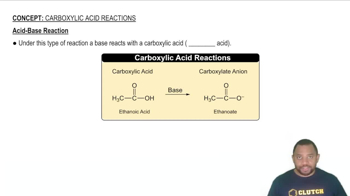
Acid-Base Reactions
Acid-base reactions involve the transfer of protons (H+) between reactants. In the context of oxides, acidic solutions can react with basic oxides to form soluble salts and water. Understanding the nature of the oxide—whether it behaves as an acid or a base—helps predict its solubility in acidic conditions.
Recommended video:
Guided course
Acid-Base Reaction
Solubility of Metal Oxides
The solubility of metal oxides in acidic solutions often depends on the metal's oxidation state and the oxide's basicity. Basic oxides, such as BaO, typically react with acids to form soluble salts, while amphoteric oxides, like B2O3, can react with both acids and bases, influencing their solubility in acidic environments.
Recommended video:
Guided course
Oxide Reactions
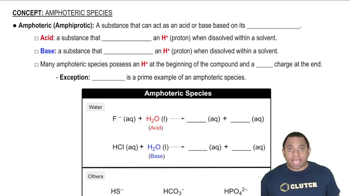
Amphoteric Behavior
Amphoteric oxides can react with both acids and bases, exhibiting dual behavior. For example, B2O3 can dissolve in acidic solutions, while SiO2 is generally considered insoluble. Recognizing which oxides are amphoteric is crucial for determining their solubility in acidic conditions.
Recommended video:
Guided course
Amphoteric Species
Related Practice
Textbook Question
96
views
Textbook Question
The following models represent the structures of binary hydrides
of second-row elements:
(a) Identify the nonhydrogen atom in each case, and write the molecular formula for each hydride.
106
views
Textbook Question
In what forms is oxygen commonly found in nature?
95
views
Textbook Question
Describe the structures of the white and red allotropes of phosphorus, and explain why white phosphorus is so reactive.
79
views
Textbook Question
Explain why the properties of boron differ so markedly from the properties of the other group 3A elements.
198
views
Textbook Question
Which of the group 4A elements have allotropes with the diamond structure? Which have metallic allotropes? How does the variation in the structure of the group 4A elements illustrate how metallic character varies down a periodic group?
87
views