Calculate the mass percent composition of each of the following substances. (c) Prussian blue, an ink pigment: Fe4[Fe(CN)6]3
Ch.3 - Mass Relationships in Chemical Reactions
Chapter 3, Problem 89
Ferrocene, a substance proposed for use as a gasoline additive, has the percent composition 5.42% H, 64.56% C, and 30.02% Fe. What is the empirical formula of ferrocene?
Verified step by step guidance1
Assume you have 100 grams of ferrocene, which allows you to directly convert the percentage of each element to grams: 5.42 g of H, 64.56 g of C, and 30.02 g of Fe.
Convert the mass of each element to moles by dividing by their respective molar masses: \( \text{H: } \frac{5.42 \text{ g}}{1.01 \text{ g/mol}} \), \( \text{C: } \frac{64.56 \text{ g}}{12.01 \text{ g/mol}} \), \( \text{Fe: } \frac{30.02 \text{ g}}{55.85 \text{ g/mol}} \).
Determine the mole ratio of the elements by dividing each element's mole value by the smallest number of moles calculated in the previous step.
Round the mole ratios to the nearest whole number to find the subscripts for each element in the empirical formula.
Write the empirical formula using the whole number mole ratios as subscripts for each element.

Verified video answer for a similar problem:
This video solution was recommended by our tutors as helpful for the problem above.
Video duration:
2mWas this helpful?
Key Concepts
Here are the essential concepts you must grasp in order to answer the question correctly.
Percent Composition
Percent composition refers to the percentage by mass of each element in a compound. It is calculated by dividing the mass of each element in a sample by the total mass of the compound and multiplying by 100. Understanding percent composition is essential for determining the relative amounts of each element, which is a crucial step in finding the empirical formula.
Empirical Formula
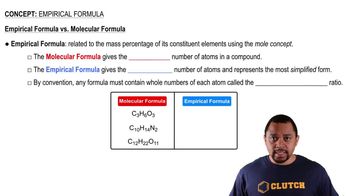
The empirical formula of a compound represents the simplest whole-number ratio of the elements present. It is derived from the percent composition by converting the percentages to moles and then simplifying the mole ratios. This formula provides insight into the basic structure of the compound without detailing the actual number of atoms in a molecule.
Recommended video:
Guided course
Empirical vs Molecular Formula
Mole Concept
The mole concept is a fundamental principle in chemistry that relates the mass of a substance to the number of particles it contains. One mole of any substance contains Avogadro's number (approximately 6.022 x 10^23) of entities, whether they are atoms, molecules, or ions. This concept is crucial for converting percent composition to moles, which is necessary for calculating the empirical formula.
Recommended video:
Guided course
Mole Concept
Related Practice
Textbook Question
565
views
Textbook Question
What are the empirical formulas of each of the following substances? (c) Zircon, a mineral from which cubic zirconia is made: 34.91% O, 15.32% Si, 49.77% Zr
808
views
Textbook Question
What are the empirical formulas of substances with the following mass percent compositions? (b) Ilmenite (a titanium-containing ore): 31.63% O, 31.56% Ti, 36.81% Fe
764
views
Textbook Question
What is the empirical formula of stannous fluoride, the first fluoride compound added to toothpaste to protect teeth against decay? Its mass percent composition is 24.25% F, 75.75% Sn.
655
views
Textbook Question
What are the empirical formulas of substances with the following mass percent compositions? (c) Sodium thiosulfate (photographic 'fixer'): 30.36% O, 29.08% Na, 40.56% S
791
views
Textbook Question
What are the empirical formulas of each of the following substances? (b) Magnetite, a naturally occurring magnetic mineral: 72.36% Fe, 27.64% O
741
views