Ch.6 - Ionic Compounds: Periodic Trends and Bonding Theory
McMurry - Chemistry 8th Edition
McMurry8th EditionChemistryISBN: 9781292336145Not the one you use?Change textbook
Chapter 6, Problem 12a

Given the following information, construct a Born–Haber cycle to calculate the lattice energy of CaCl2(s). (LO 6.13)
Net energy change for the formation of CaCl2(s) form Ca(s) and Cl2(g) = -795.4 kJ/mol
Heat of sublimation for Ca(s) = +178 kJ/mol
Ei1 for Ca(s) = +590 kJ/mol
Ei2 for Ca(g) = +1145 kJ/mol
Bond dissociation energy for Cl2(g) = +243 kJ/mol
Eea1 for Cl(g) = -348.6 kJ/mol
(a) 2603 kJ/mol (b) 2254 kJ/mol (c) 2481 kJ/mo (d) 1663 kJ/mol

Verified step by step guidance
1
Step 1: Start by writing the formation equation for CaCl2(s) from its elements in their standard states: Ca(s) + Cl2(g) → CaCl2(s).
Step 2: Include the given enthalpy change for the formation of CaCl2(s), which is -795.4 kJ/mol. This value represents the overall energy change for the reaction.
Step 3: Add the individual steps and their corresponding energies to the cycle: sublimation of Ca(s) to Ca(g) (+178 kJ/mol), first ionization energy of Ca(g) to Ca+(g) (+590 kJ/mol), second ionization energy of Ca+(g) to Ca2+(g) (+1145 kJ/mol), bond dissociation of Cl2(g) to 2Cl(g) (+243 kJ/mol), and electron affinity of Cl(g) to form Cl-(g) (-348.6 kJ/mol for each Cl, total -697.2 kJ/mol for two Cl atoms).
Step 4: Arrange these steps around a cycle, connecting the initial reactants to the final product, CaCl2(s), ensuring that the cycle balances both mass and charge.
Step 5: Solve for the lattice energy of CaCl2(s) by using Hess's Law, which states that the total enthalpy change for the cycle must equal zero. Rearrange the equation to solve for the lattice energy, which is the only unknown in the cycle.

Verified video answer for a similar problem:

This video solution was recommended by our tutors as helpful for the problem above.
Video duration:
8m
Was this helpful?

Key Concepts

Here are the essential concepts you must grasp in order to answer the question correctly.

Born-Haber Cycle

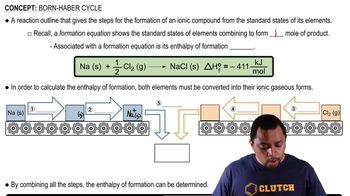
The Born-Haber cycle is a thermodynamic cycle that relates the lattice energy of an ionic compound to the enthalpy changes involved in its formation from its constituent elements. It combines various energy changes, including sublimation, ionization, bond dissociation, and electron affinity, to calculate the lattice energy, which is the energy released when gaseous ions form a solid ionic lattice.
Recommended video:
Guided course
03:49
Born Haber Cycle

Lattice Energy

Lattice energy is the amount of energy released when one mole of an ionic solid is formed from its gaseous ions. It is a measure of the strength of the forces between the ions in an ionic compound. A higher lattice energy indicates a more stable ionic compound, as it reflects stronger ionic bonds due to greater charge and smaller ionic radii.
Recommended video:
Guided course
00:49
Lattice Energy

Enthalpy Changes

Enthalpy changes are the heat changes that occur during chemical reactions or phase changes at constant pressure. In the context of the Born-Haber cycle, these include the heat of sublimation, ionization energies, bond dissociation energies, and electron affinities. Understanding these enthalpy changes is crucial for accurately calculating the overall energy change associated with the formation of ionic compounds.
Related Practice
Textbook Question

Which molecular scale image best represents the ionic com-pound that forms between cesium and chlorine? (Cesium is represented by red circles, and chlorine is represented by blue circles.) (LO 6.12) (a)

(b)

(c)

(d)

273
views

Textbook Question

Given the following values for steps in the formation of CaO(s) from its elements, draw a Born–Haber cycle similar to that shown in Figure 6.7. Eea1 for O1g2 = -141 kJ/mol Eea2 for O1g2 = 745.1 kJ/mol Heat of sublimation for Ca1s2 = 178 kJ/mol Ei1 for Ca1g2 = 590 kJ/mol Ei1 for Ca1g2 = 1145 kJ/mol Bond dissociation energy for O21g2 = 498 kJ/mol Lattice energy for CaO1s2 = 3401 kJ/mol

559
views
Textbook Question

Three binary compounds are represented on the following drawing: red with red, blue with blue, and green with green. Give a likely formula for each compound.

499
views
Textbook Question
Which element has the largest atomic radius? (LO 5.20) (a) Rb (b) Co(c) Mgd) As
917
views
Textbook Question
Elements that have large negative electron affinities generally have (LO 6.10) (a) high values for Zeff and a vacancy in a valence orbital. (b) low values for Zeff and a vacancy in a valence orbital. (c) high values for Zeff and filled valence orbitals. (d) low values for Zeff and filled valence orbitals.
443
views
Textbook Question
For a multielectron atom, a 3s orbital lies lower in energy than a 3p orbital because (LO 5.16)(a) a 3p orbital has more nodal surfaces than a 3s orbital. (b) an electron in a 3p orbital has a higher probability of being closer to the nucleus than an electron in a 3s orbital.(c) inner electrons shield electrons in a 3p orbital more effec-tively than electrons in a 3s orbital. (d) the energy of the electron can be spread between three 3p orbitals instead of only one 3s orbital.
1786
views