
Given the following values for steps in the formation of CaO(s) from its elements, draw a Born–Haber cycle similar to that shown in Figure 6.7. Eea1 for O1g2 = -141 kJ/mol Eea2 for O1g2 = 745.1 kJ/mol Heat of sublimation for Ca1s2 = 178 kJ/mol Ei1 for Ca1g2 = 590 kJ/mol Ei1 for Ca1g2 = 1145 kJ/mol Bond dissociation energy for O21g2 = 498 kJ/mol Lattice energy for CaO1s2 = 3401 kJ/mol
Ch.6 - Ionic Compounds: Periodic Trends and Bonding Theory
All textbooks
McMurry 8th Edition
Ch.6 - Ionic Compounds: Periodic Trends and Bonding Theory
Problem 31
McMurry 8th Edition
Ch.6 - Ionic Compounds: Periodic Trends and Bonding Theory
Problem 31Chapter 6, Problem 31
Three binary compounds are represented on the following drawing: red with red, blue with blue, and green with green. Give a likely formula for each compound.
Verified step by step guidance1
Step 1: The problem statement does not provide specific information about the elements represented by the colors red, blue, and green. However, we can make educated guesses based on the information given. In chemistry, a binary compound is a compound composed of exactly two different elements. The simplest binary compounds are binary ionic compounds, which are formed by the combination of a metal and a nonmetal.
Step 2: Let's assume that the red, blue, and green colors each represent a different element. Since we're dealing with binary compounds, each compound will be composed of two atoms of the same element. Therefore, the formula for each compound will be X2, where X is the element represented by the color.
Step 3: So, the likely formula for the compound represented by red with red would be Red2, for blue with blue would be Blue2, and for green with green would be Green2.
Step 4: Please note that these are not actual chemical formulas, but rather placeholders for the actual elements. The actual formulas would depend on the specific elements represented by the colors red, blue, and green.
Step 5: It's also important to note that not all elements form stable diatomic molecules (molecules composed of two atoms of the same element). The elements that do form stable diatomic molecules are hydrogen (H2), nitrogen (N2), oxygen (O2), fluorine (F2), chlorine (Cl2), bromine (Br2), and iodine (I2). These are often remembered using the mnemonic 'HONClBrIF'.

Verified video answer for a similar problem:
This video solution was recommended by our tutors as helpful for the problem above.
Video duration:
8mWas this helpful?
Key Concepts
Here are the essential concepts you must grasp in order to answer the question correctly.
Binary Compounds
Binary compounds are chemical compounds composed of two different elements. They can be ionic or covalent, depending on the nature of the bonding between the elements. Understanding the types of elements involved (metals vs. nonmetals) helps in predicting the formula and properties of the compound.
Recommended video:
Guided course
Binary Acids
Chemical Formulas
A chemical formula represents the elements in a compound and their respective quantities. For binary compounds, the formula typically follows the convention of writing the more electropositive element first, followed by the more electronegative element. This notation provides insight into the composition and stoichiometry of the compound.
Recommended video:
Guided course
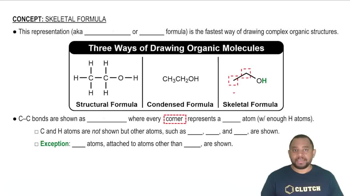
Skeletal Formula
Color Coding in Chemistry
In the context of the question, color coding (red, blue, green) likely represents different elements or types of atoms. This visual representation can help in identifying which elements combine to form the binary compounds. Recognizing these associations is crucial for accurately determining the likely formulas based on the given colors.
Related Practice
Textbook Question
559
views
Textbook Question
What is the difference between a molecule and an ion?
288
views
Textbook Question
Given the following information, construct a Born–Haber cycle to calculate the lattice energy of CaCl2(s). (LO 6.13)
Net energy change for the formation of CaCl2(s) form Ca(s) and Cl2(g) = -795.4 kJ/mol
Heat of sublimation for Ca(s) = +178 kJ/mol
Ei1 for Ca(s) = +590 kJ/mol
Ei2 for Ca(g) = +1145 kJ/mol
Bond dissociation energy for Cl2(g) = +243 kJ/mol
Eea1 for Cl(g) = -348.6 kJ/mol
(a) 2603 kJ/mol (b) 2254 kJ/mol (c) 2481 kJ/mo (d) 1663 kJ/mol
708
views
Textbook Question
Which element has the largest atomic radius? (LO 5.20) (a) Rb (b) Co(c) Mgd) As
917
views
Textbook Question
Label the following species as molecules or ions. (a) NO3– (b) NH4+ (d) CH3CO2–
493
views
Textbook Question
For a multielectron atom, a 3s orbital lies lower in energy than a 3p orbital because (LO 5.16)(a) a 3p orbital has more nodal surfaces than a 3s orbital. (b) an electron in a 3p orbital has a higher probability of being closer to the nucleus than an electron in a 3s orbital.(c) inner electrons shield electrons in a 3p orbital more effec-tively than electrons in a 3s orbital. (d) the energy of the electron can be spread between three 3p orbitals instead of only one 3s orbital.
1786
views