
Several processes are given in the table and labeled as endo- thermic or exothermic and given a sign for ∆H°. Which process is labeled with the correct sign of ∆H° and correct classification as endothermic or exothermic? (LO 9.8) Process (c) Water freezes into ice in the freezer.
Ch.9 - Thermochemistry: Chemical Energy
Chapter 9, Problem 7
How much heat is required to raise a 50.0 g piece of iron from 25 °C to its melting point of 1538 °C? The specific heat capacity for iron is 0.451 J/g•°C.(a) 34.1 kJ(b) 168 kJ(c) 12.1 kJ(d) 6.78 kJ
Verified step by step guidance1
Identify the given values: mass of iron (m) = 50.0 g, initial temperature (T_initial) = 25 °C, final temperature (T_final) = 1538 °C, and specific heat capacity of iron (c) = 0.451 J/g•°C.
Understand the formula for heat transfer, which is Q = m * c * ΔT, where Q is the heat required, m is the mass, c is the specific heat capacity, and ΔT is the change in temperature.
Calculate the change in temperature (ΔT) by subtracting the initial temperature from the final temperature: ΔT = T_final - T_initial.
Substitute the values into the heat transfer formula: Q = 50.0 g * 0.451 J/g•°C * (1538 °C - 25 °C).
Convert the result from joules to kilojoules by dividing by 1000, as 1 kJ = 1000 J.

Verified video answer for a similar problem:
This video solution was recommended by our tutors as helpful for the problem above.
Video duration:
2mWas this helpful?
Key Concepts
Here are the essential concepts you must grasp in order to answer the question correctly.
Specific Heat Capacity
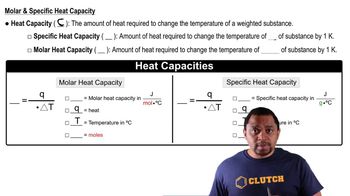
Specific heat capacity is the amount of heat required to raise the temperature of one gram of a substance by one degree Celsius. It is a material-specific property that indicates how much energy is needed to change the temperature of a substance, which is crucial for calculating heat transfer in thermal processes.
Recommended video:
Guided course
Heat Capacity
Heat Transfer Calculation
The heat transfer (q) required to change the temperature of a substance can be calculated using the formula q = m × c × ΔT, where m is the mass, c is the specific heat capacity, and ΔT is the change in temperature. This formula allows us to quantify the energy needed for temperature changes in various materials.
Phase Change and Melting Point
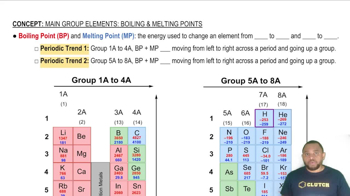
The melting point is the temperature at which a solid becomes a liquid. In this context, understanding the melting point of iron (1538 °C) is essential, as it indicates the temperature to which the iron must be heated. The energy required to reach this temperature from an initial state is calculated using the specific heat capacity.
Recommended video:
Guided course
Boiling Point and Melting Point
Related Practice
Textbook Question
287
views
Textbook Question
Several processes are given in the table and labeled as endo- thermic or exothermic and given a sign for ∆H°. Which process is labeled with the correct sign of ∆H° and correct classification as endothermic or exothermic? (LO 9.8) Process (d) Rubbing alcohol evaporates from your skin.
263
views
Textbook Question
Several processes are given in the table and labeled as endo- thermic or exothermic and given a sign for ∆H°. Which process is labeled with the correct sign of ∆H° and correct classification as endothermic or exothermic? (LO 9.8) Process (b) Methane, the main component of natural gas, is burned to produce a flame on a stovetop.
273
views
Textbook Question
Calculate the enthalpy change for the reactionC(s) + 2 H2(g) → CH4(g) ΔH = ?Given the enthalpy values for the following reactionsCH4(g) + 2 O2(g) → CO2(g) + 2 H2O(l) ΔH = −890.4 kJC(s) + O2(g) → CO2(g) ΔH = −393.5 kJH2(g) + 1/2 O2(g) → H2O (g) ΔH = −285.8 kJ(a) −1569.7 kJ(b) +211.1 kJ(c) −1855.5 kJ(d) −74.7 kJ
4125
views
Textbook Question
A table of standard enthalpies of formation (ΔH°f) gives a value of −467.9 kJ/mol for NaNO3(s). Which reaction has a ΔH° value of −467.9 kJ?(a) Na+ (aq) + NO3−(aq) → NaNO3(s)(b) Na(s) + N(g + O3(g) → NaNO3(s)(c) Na(s) + 1/2 N2(g) + 3/2 O2(g) → NaNO3(s)(d) 2 Na(s) + N2(g) + 3 O2(g) → 2 NaNO3(s)
2474
views
Textbook Question
A 25.0 g piece of granite at 100.0°C was added to 100.0 g of water of 25.0°C, and the temperature rose to 28.4°C. What is the specific heat capacity of the granite? (The specific heat capacity for water is 4.18 J/(g•°C).) (LO 9.10)(a) 0.563 J/(g•°C)(b) 1.53 J/(g•°C)(c) 0.992 J/(g•°C)(d) 0.794 J/(g•°C)
1328
views
