
Several processes are given in the table and labeled as endo- thermic or exothermic and given a sign for ∆H°. Which process is labeled with the correct sign of ∆H° and correct classification as endothermic or exothermic? (LO 9.8) Process (d) Rubbing alcohol evaporates from your skin.
Ch.9 - Thermochemistry: Chemical Energy
Chapter 9, Problem 6c
Several processes are given in the table and labeled as endo- thermic or exothermic and given a sign for ∆H°. Which process is labeled with the correct sign of ∆H° and correct classification as endothermic or exothermic? (LO 9.8) Process (c) Water freezes into ice in the freezer.
Verified step by step guidance1
Identify the process: Water freezing into ice.
Recall that freezing is a phase change from liquid to solid.
Understand that during freezing, energy is released as the molecules lose kinetic energy and form a more ordered structure.
Recognize that processes that release energy are classified as exothermic.
Conclude that the correct sign for \( \Delta H^\circ \) for an exothermic process is negative.
Key Concepts
Here are the essential concepts you must grasp in order to answer the question correctly.
Enthalpy Change (∆H°)
Enthalpy change, denoted as ∆H°, is a measure of the heat content of a system at constant pressure. It indicates whether a process absorbs heat (endothermic, ∆H° > 0) or releases heat (exothermic, ∆H° < 0). Understanding this concept is crucial for classifying chemical and physical processes based on their thermal energy changes.
Endothermic and Exothermic Processes
Endothermic processes absorb heat from their surroundings, resulting in a positive enthalpy change (∆H° > 0), while exothermic processes release heat, leading to a negative enthalpy change (∆H° < 0). Recognizing these classifications helps predict the thermal behavior of reactions and physical changes, such as melting and freezing.
Recommended video:
Guided course
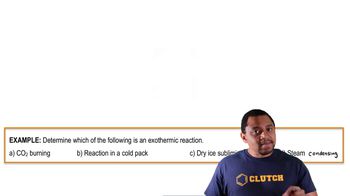
Endothermic & Exothermic Reactions Example 2
Phase Changes
Phase changes, such as freezing and melting, involve transitions between solid, liquid, and gas states. The freezing of water into ice is an exothermic process because it releases heat to the surroundings, resulting in a negative ∆H°. Understanding phase changes is essential for correctly identifying the thermal nature of processes involving state transitions.
Recommended video:
Guided course
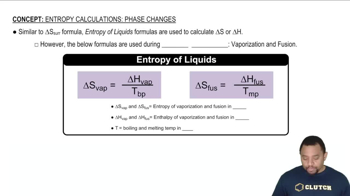
Entropy in Phase Changes
Related Practice
Textbook Question
263
views
Textbook Question
Several processes are given in the table and labeled as endo- thermic or exothermic and given a sign for ∆H°. Which process is labeled with the correct sign of ∆H° and correct classification as endothermic or exothermic? (LO 9.8) Process (b) Methane, the main component of natural gas, is burned to produce a flame on a stovetop.
273
views
Textbook Question
For which of the following reactions are ΔE and ΔH equal? (a) CO2(g) + H2O(l) → H2CO(b) 2 NaHCO3 (s) → Na2CO3(s) + H2O(g) + CO2(g)(c) 2 H2(g) + O2(g) → 2 H2O(g)(d) CH4(g) + 2 O2(g) → CO2(g) + 2 H2O(g)
723
views
Textbook Question
How much heat is required to raise a 50.0 g piece of iron from 25 °C to its melting point of 1538 °C? The specific heat capacity for iron is 0.451 J/g•°C.(a) 34.1 kJ(b) 168 kJ(c) 12.1 kJ(d) 6.78 kJ
4746
views
Textbook Question
A 25.0 g piece of granite at 100.0°C was added to 100.0 g of water of 25.0°C, and the temperature rose to 28.4°C. What is the specific heat capacity of the granite? (The specific heat capacity for water is 4.18 J/(g•°C).) (LO 9.10)(a) 0.563 J/(g•°C)(b) 1.53 J/(g•°C)(c) 0.992 J/(g•°C)(d) 0.794 J/(g•°C)
1328
views
Textbook Question
Several processes are given in the table and labeled as endo- thermic or exothermic and given a sign for ∆H°. Which process is labeled with the correct sign of ∆H° and correct classification as endothermic or exothermic? (LO 9.8) Process (a) Ammonium nitrate dissolves in water, and the temperature of the solution decreases.
311
views
1
rank
