Back
Back
Problem 100
Use Lewis structures to explain why Br3- and I3- are stable, while F3- is not.
Problem 102
Draw the Lewis structure for urea, H2NCONH2, one of the compounds responsible for the smell of urine. (The central carbon atom is bonded to both nitrogen atoms and to the oxygen atom.) Does urea contain polar bonds? Which bond in urea is most polar?
- Draw Lewis structures for each free radical implicated in this theory of aging: a. O2- b. O-
Problem 103
Problem 103c
Some theories of aging suggest that free radicals cause certain diseases and perhaps aging in general. As you know from the Lewis model, such molecules are not chemically stable and will quickly react with other molecules. According to certain theories, free radicals may attack molecules within the cell, such as DNA, changing them and causing cancer or other diseases. Free radicals may also attack molecules on the surfaces of cells, making them appear foreign to the body's immune system. The immune system then attacks the cells and destroys them, weakening the body. Draw Lewis structures for each free radical implicated in this theory of aging. c. OH
Problem 103d
Some theories of aging suggest that free radicals cause certain diseases and perhaps aging in general. As you know from the Lewis model, such molecules are not chemically stable and will quickly react with other molecules. According to certain theories, free radicals may attack molecules within the cell, such as DNA, changing them and causing cancer or other diseases. Free radicals may also attack molecules on the surfaces of cells, making them appear foreign to the body's immune system. The immune system then attacks the cells and destroys them, weakening the body. Draw Lewis structures for each free radical implicated in this theory of aging. d. CH3OO (unpaired electron on terminal oxygen)
Problem 104
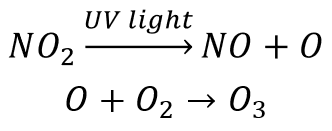
Free radicals are important in many environmentally significant reactions (see the Chemistry in the Environment box on free radicals in this chapter). For example, photochemical smog— smog that results from the action of sunlight on air pollutants— forms in part by these two steps:
The product of this reaction, ozone, is a pollutant in the lower atmosphere. (Upper atmospheric ozone is a natural part of the atmosphere that protects life on Earth from ultraviolet light.) Ozone is an eye and lung irritant and also accelerates the weathering of rubber products. Rewrite the given reactions using the Lewis structure of each reactant and product. Identify the free radicals.
Problem 105a
If hydrogen were used as a fuel, it could be burned according to this reaction: H2(g) + 1/2 O2(g) → H2O(g) Use average bond energies to calculate ΔHrxn for this reaction.
Problem 105b
If hydrogen were used as a fuel, it could be burned according to this reaction: H2(g) + 1/2 O2(g) → H2O(g) Use average bond energies to calculate ΔHrxn for the combustion of methane (CH4).
Problem 105c
If hydrogen were used as a fuel, it could be burned according to this reaction: H2(g) + 1/2 O2(g) → H2O(g) Which fuel yields more energy per mole?
Problem 105d
If hydrogen were used as a fuel, it could be burned according to this reaction: H2(g) + 1/2 O2(g) → H2O(g) Which fuel yields more energy per gram?
Problem 106
Calculate ΔHrxn for the combustion of octane (C8H18), a component of gasoline, by using average bond energies and then calculate it using enthalpies of formation from Appendix IIB. What is the percent difference between your results? Which result would you expect to be more accurate?
Problem 107c
Draw the Lewis structure for each compound. c. H3AsO4
Problem 108
The azide ion, N3-, is a symmetrical ion, all of whose contributing resonance structures have formal charges. Draw three important contributing structures for this ion.
Problem 112
Calculate the heat of atomization (see previous problem) of C2H3Cl, using the average bond energies in Table 10.3.
Problem 113
A compound composed of only carbon and hydrogen is 7.743% hydrogen by mass. Propose a Lewis structure for the compound.
Problem 114
A compound composed of only carbon and chlorine is 85.5% chlorine by mass. Propose a Lewis structure for the compound.