Ch.1 - Matter, Measurement & Problem Solving
Tro - Chemistry: A Molecular Approach 6th Edition
Tro6th EditionChemistry: A Molecular ApproachISBN: 9780137832217Not the one you use?Change textbook
Chapter 1, Problem 44

Classify each of the listed properties of ozone (a pollutant in the lower atmosphere but part of a protective shield against UV light in the upper atmosphere) as physical or chemical. a. bluish color b. pungent odor c. very reactive d. decomposes on exposure to ultraviolet light e. gas at room temperature

Verified step by step guidance
1
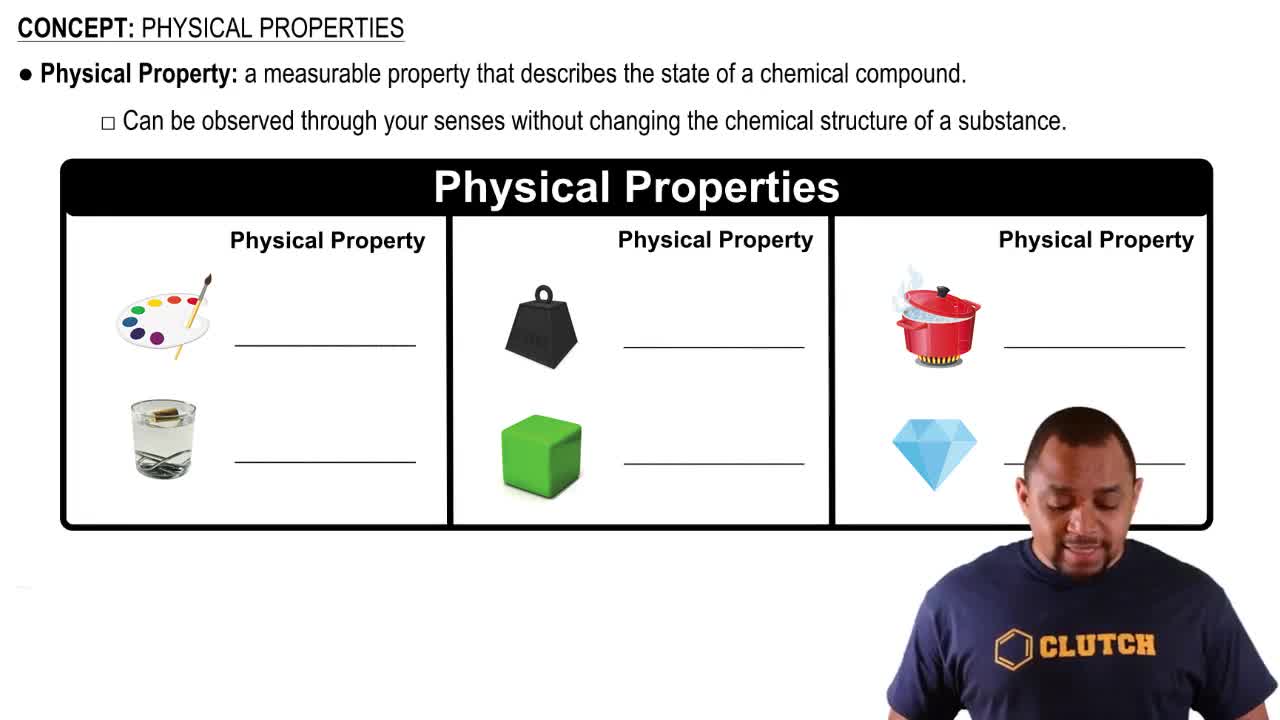
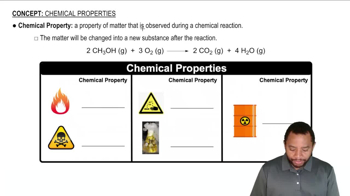
Identify the nature of each property: physical properties are those that can be observed without changing the substance's chemical identity, while chemical properties describe the substance's ability to undergo a chemical change.
For property (a) 'bluish color': Determine if observing the color changes the chemical identity of ozone. Since color is an observable trait without altering the substance, classify it as a physical property.
For property (b) 'pungent odor': Consider if detecting the odor involves a chemical change. Since odor is a sensory perception that doesn't change the chemical identity, classify it as a physical property.
For property (c) 'very reactive': Evaluate if this describes a tendency to undergo chemical changes. Since reactivity involves chemical transformations, classify it as a chemical property.
For property (d) 'decomposes on exposure to ultraviolet light': Determine if this involves a chemical change. Decomposition is a chemical reaction, so classify it as a chemical property. For property (e) 'gas at room temperature': Consider if this state of matter involves a chemical change. Since being a gas is a physical state, classify it as a physical property.

Key Concepts

Here are the essential concepts you must grasp in order to answer the question correctly.

Physical Properties

Physical properties are characteristics of a substance that can be observed or measured without changing its chemical identity. Examples include color, odor, and state of matter. In the context of ozone, properties like its bluish color and being a gas at room temperature are physical, as they do not involve any chemical reactions.
Recommended video:
Guided course
02:54
Physical Properties

Chemical Properties

Chemical properties describe a substance's ability to undergo chemical changes or reactions. These properties are observed during a chemical reaction and include reactivity and decomposition. For ozone, its reactivity and the fact that it decomposes upon exposure to ultraviolet light are chemical properties, indicating how it interacts with other substances.
Recommended video:
Guided course
03:37
Chemical Properties

Ozone's Role in the Atmosphere

Ozone plays a dual role in the atmosphere: it acts as a pollutant in the lower atmosphere, contributing to smog and respiratory issues, while in the upper atmosphere, it forms a protective layer that absorbs harmful ultraviolet (UV) radiation from the sun. Understanding this duality is essential for classifying its properties accurately, as they can vary significantly based on its location in the atmosphere.
Recommended video:
Guided course
01:13
Osmotic Pressure Formula