Determine whether each molecule is polar or nonpolar. c. SeCl6

Ch.11 - Chemical Bonding II: Molecular Shapes, VSEPR & MO Theory

All textbooks
Tro 6th Edition
Ch.11 - Chemical Bonding II: Molecular Shapes, VSEPR & MO Theory
Problem 49
Tro 6th Edition
Ch.11 - Chemical Bonding II: Molecular Shapes, VSEPR & MO Theory
Problem 49Chapter 11, Problem 49
Determine whether each molecule in Exercise 35 is polar or nonpolar.
a. CI4
b. NCl3
c. OF2
d. H2S
Verified step by step guidance1
Determine the molecular geometry of each molecule using VSEPR theory.
For each molecule, identify the electronegativity of each atom involved.
Assess the symmetry of the molecule to determine if the dipoles cancel out.
For each molecule, evaluate if there is a net dipole moment.
Conclude whether each molecule is polar or nonpolar based on the presence of a net dipole moment.
Key Concepts
Here are the essential concepts you must grasp in order to answer the question correctly.
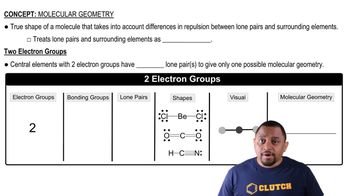
Molecular Geometry
Molecular geometry refers to the three-dimensional arrangement of atoms within a molecule. The shape of a molecule is determined by the number of bonding pairs and lone pairs of electrons around the central atom, which can influence the distribution of charge and ultimately the polarity of the molecule.
Recommended video:
Guided course
Molecular Geometry with Two Electron Groups
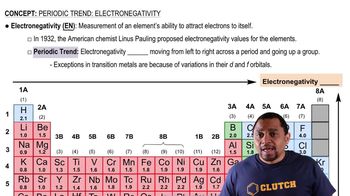
Electronegativity
Electronegativity is a measure of an atom's ability to attract and hold onto electrons in a chemical bond. Differences in electronegativity between bonded atoms can lead to polar covalent bonds, where electrons are shared unequally, resulting in partial positive and negative charges that contribute to the overall polarity of the molecule.
Recommended video:
Guided course
Electronegativity Trends
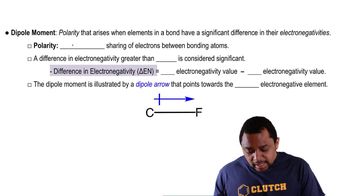
Dipole Moment
A dipole moment is a vector quantity that represents the separation of positive and negative charges in a molecule. It is influenced by both the electronegativity of the atoms and the molecular geometry. A molecule is considered polar if it has a net dipole moment, indicating an uneven distribution of electron density.
Recommended video:
Guided course
Dipole Moment
Related Practice
Textbook Question
Textbook Question
Determine the geometry about each interior atom in each molecule and sketch the molecule. (Skeletal structure is indicated in parentheses.) c. NH2CO2H (H2NCOOH both O atoms attached to C)
1111
views
Textbook Question
Determine the geometry about each interior atom in each molecule and sketch the molecule. (Skeletal structure is indicated in parentheses.)
a. CH3NH2 (H3CNH2)
b. CH3CO2CH3 (H3CCOOCH3 One O atom attached to 2nd C atom; the other O atom is bonded to the 2nd and 3rd C atom)
1815
views
Textbook Question
Determine whether each molecule in Exercise 36 is polar or nonpolar.
a. CS2
b. SCl2
c. CHF3
d. PF3
Textbook Question
Determine whether each molecule is polar or nonpolar. b. SiCl4
1
views
Textbook Question
CH3F is a polar molecule, even though the tetrahedral geometry often leads to nonpolar molecules. Explain.
4481
views