To what volume should you dilute 50.0 mL of a 3.00 M KI solution so that 25.0 mL of the diluted solution contains 2.55 g of KI?
Ch.14 - Solutions

Chapter 14, Problem 63
A hard water sample contains 0.0085% Ca by mass (in the form of Ca2+ ions). How much water (in grams) contains 1.2 g of Ca? (1.2 g of Ca is the recommended daily allowance of calcium for adults between 19 and 24 years old.)
Verified step by step guidance1
Identify the percentage of calcium in the water sample, which is given as 0.0085% by mass.
Understand that this means there are 0.0085 grams of calcium in every 100 grams of water.
Set up a proportion to find out how many grams of water contain 1.2 grams of calcium. Use the relationship: (0.0085 g Ca / 100 g water) = (1.2 g Ca / x g water).
Solve the proportion for x, which represents the mass of water that contains 1.2 grams of calcium.
Rearrange the equation to solve for x: x = (1.2 g Ca * 100 g water) / 0.0085 g Ca.
Key Concepts
Here are the essential concepts you must grasp in order to answer the question correctly.
Mass Percentage
Mass percentage is a way of expressing the concentration of a component in a mixture. It is calculated by taking the mass of the component, dividing it by the total mass of the mixture, and multiplying by 100. In this question, the mass percentage of calcium in hard water is given as 0.0085%, which indicates that for every 100 grams of hard water, there are 0.0085 grams of calcium.
Stoichiometry
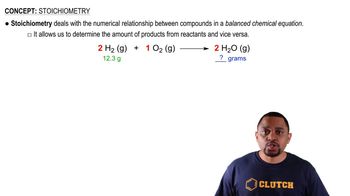
Stoichiometry is the branch of chemistry that deals with the quantitative relationships between the reactants and products in a chemical reaction. In this context, stoichiometry helps us determine how much water is needed to contain a specific mass of calcium. By using the mass percentage of calcium, we can set up a proportion to find the total mass of water required to achieve the desired amount of calcium.
Recommended video:
Guided course
Stoichiometry Concept
Conversion of Units
Conversion of units is essential in chemistry to ensure that measurements are compatible and calculations yield accurate results. In this problem, we need to convert the mass of calcium (1.2 g) into the corresponding mass of hard water using the mass percentage. Understanding how to convert between grams of calcium and grams of water is crucial for solving the problem correctly.
Recommended video:
Guided course
Conversion Factors
Related Practice
Textbook Question
Textbook Question
Describe how to prepare each solution from the dry solute and the solvent. b. 125 g of 0.100 m NaNO3
2304
views
1
comments
Textbook Question
Lead is a toxic metal that affects the central nervous system. A Pb-contaminated water sample contains 0.0011% Pb by mass. How much of the water (in mL) contains 150 mg of Pb? (Assume a density of 1.0 g/mL.)
1971
views
Textbook Question
A dioxin-contaminated water source contains 0.085% dioxin by mass. How much dioxin is present in 2.5 L of this water? Assume a density of 1.00 g/mL.
2095
views
2
rank
Textbook Question
An aqueous KNO3 solution is made using 55.3 g of KNO3 diluted to a total solution volume of 2.00 L. Calculate the mass percent of the solution. (Assume a density of 1.05 g>mL for the solution.)