A KNO3 solution containing 35 g of KNO3 per 100.0 g of water is cooled from 40 °C to 0 °C. What happens during cooling? (Use Figure 14.11.)

Ch.14 - Solutions

Chapter 14, Problem 46
A KNO3 solution containing 35 g of KNO3 per 100.0 g of water is cooled from 40°C to 0°C. What happens during cooling? (Use Figure 14.11.)
Verified step by step guidance1
Identify the solubility of KNO3 at 40°C using the provided solubility chart or figure.
Determine the solubility of KNO3 at 0°C using the same chart or figure.
Compare the initial concentration of KNO3 in the solution (35 g per 100 g of water) with the solubility at 40°C to confirm if the solution is saturated, unsaturated, or supersaturated at the starting temperature.
Compare the initial concentration of KNO3 with the solubility at 0°C to determine if the solution will remain saturated, become unsaturated, or if excess KNO3 will precipitate out as the solution cools.
Conclude what happens to the KNO3 in the solution during the cooling process based on the solubility changes observed.

Verified video answer for a similar problem:
This video solution was recommended by our tutors as helpful for the problem above.
Video duration:
1mWas this helpful?
Key Concepts
Here are the essential concepts you must grasp in order to answer the question correctly.
Solubility
Solubility refers to the maximum amount of a solute that can dissolve in a solvent at a given temperature and pressure. In the case of KNO3, its solubility increases with temperature, meaning more KNO3 can dissolve in water at higher temperatures. As the solution cools from 40°C to 0°C, the solubility decreases, potentially leading to the precipitation of KNO3 if the solution becomes supersaturated.
Recommended video:
Guided course
Solubility Rules
Saturation and Supersaturation
A saturated solution contains the maximum amount of solute that can dissolve at a specific temperature. When a solution is cooled, it may become supersaturated if it contains more solute than the new solubility limit allows. This condition can lead to the formation of solid crystals as the excess solute precipitates out of the solution, which is a key process to consider when cooling the KNO3 solution.
Recommended video:
Guided course
Saturated and Unsaturated Hydrocarbons
Crystallization
Crystallization is the process by which solute particles come together to form a solid crystal structure from a solution. As the KNO3 solution cools and becomes supersaturated, the solute begins to crystallize out of the solution. This process is influenced by factors such as temperature, concentration, and the presence of impurities, which can affect the size and quality of the crystals formed.
Recommended video:
Guided course
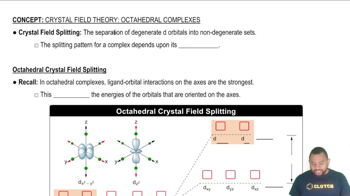
The crystal field splitting pattern for octahedral complexes has the d orbitals on or along the axes as having the higher energy.
Related Practice
Textbook Question
Textbook Question
Potassium nitrate has a lattice energy of -163.8 kcal/mol and a heat of hydration of -155.5 kcal/mol. How much potassium nitrate has to dissolve in water to absorb 1.00⨉102 kJ of heat?
2383
views
Textbook Question
Scuba divers breathing air at increased pressure can suffer from oxygen toxicity—too much oxygen in their bloodstream— when the partial pressure of oxygen exceeds about 1.4 atm. What happens to the amount of oxygen in a diver's bloodstream when he or she breathes oxygen at elevated pressures? How can this be reversed?
1102
views
Textbook Question
A solution contains 35 g of NaCl per 100.0 g of water at 25°C. Is the solution unsaturated, saturated, or supersaturated? (Use Figure 14.11.)