
A solution of a nonvolatile solute in water has a boiling point of 375.3 K. Calculate the vapor pressure of water above this solution at 338 K. The vapor pressure of pure water at this temperature is 0.2467 atm.
Ch.14 - Solutions

Chapter 14, Problem 120
Magnesium citrate, Mg3(C6H5O7)2, belongs to a class of laxatives called hyperosmotics, which cause rapid emptying of the bowel. When a concentrated solution of magnesium citrate is consumed, it passes through the intestines, drawing water and promoting diarrhea, usually within 6 hours. Calculate the osmotic pressure of a magnesium citrate laxative solution containing 28.5 g of magnesium citrate in 235 mL of solution at 37 °C (approximate body temperature). Assume complete dissociation of the ionic compound.
Verified step by step guidance1
Calculate the molar mass of magnesium citrate, Mg3(C6H5O7)2. Add the atomic masses of magnesium (Mg), carbon (C), hydrogen (H), and oxygen (O) according to the formula.
Convert the mass of magnesium citrate given (28.5 g) to moles by dividing by the molar mass calculated in the previous step.
Determine the total volume of the solution in liters by converting the volume from milliliters to liters (235 mL to L).
Calculate the molarity of the solution by dividing the number of moles of magnesium citrate by the volume of the solution in liters.
Use the formula for osmotic pressure: \( \Pi = iMRT \), where \( \Pi \) is the osmotic pressure, \( i \) is the van't Hoff factor (number of particles the compound dissociates into), \( M \) is the molarity of the solution, \( R \) is the ideal gas constant (0.0821 L atm / K mol), and \( T \) is the temperature in Kelvin. Convert 37 °C to Kelvin and calculate the osmotic pressure assuming complete dissociation of magnesium citrate into ions.

Verified video answer for a similar problem:
This video solution was recommended by our tutors as helpful for the problem above.
Video duration:
2mWas this helpful?
Key Concepts
Here are the essential concepts you must grasp in order to answer the question correctly.
Osmotic Pressure
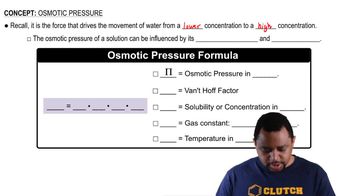
Osmotic pressure is the pressure required to prevent the flow of solvent into a solution through a semipermeable membrane. It is directly proportional to the concentration of solute particles in the solution, as described by the formula π = iCRT, where π is osmotic pressure, i is the van 't Hoff factor (number of particles the solute dissociates into), C is the molar concentration, R is the ideal gas constant, and T is the temperature in Kelvin.
Recommended video:
Guided course
Osmotic Pressure Formula
Van 't Hoff Factor
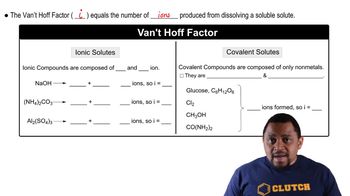
The van 't Hoff factor (i) indicates the number of particles into which a solute dissociates in solution. For magnesium citrate, which dissociates into three magnesium ions (Mg²⁺) and two citrate ions (C6H5O7³⁻), the total number of particles is five. This factor is crucial for calculating osmotic pressure, as it affects the effective concentration of solute particles in the solution.
Recommended video:
Guided course
Van't Hoff Factor
Molarity and Dilution
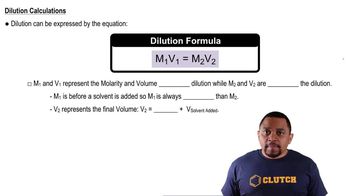
Molarity (M) is a measure of concentration defined as the number of moles of solute per liter of solution. To calculate osmotic pressure, one must first determine the molarity of magnesium citrate in the solution. This involves converting the mass of magnesium citrate into moles using its molar mass and then dividing by the volume of the solution in liters. Understanding molarity is essential for accurately applying the osmotic pressure formula.
Recommended video:
Guided course
Dilution Equation
Related Practice
Textbook Question
2683
views
1
comments
Textbook Question
The vapor pressure of carbon tetrachloride, CCl4, is 0.354 atm, and the vapor pressure of chloroform, CHCl3, is 0.526 atm at 316 K. A solution is prepared from equal masses of these two compounds at this temperature. Calculate the mole fraction of the chloroform in the vapor above the solution. If the vapor above the original solution is condensed and isolated into a separate flask, what will the vapor pressure of chloroform be above this new solution?
2670
views
Textbook Question
An isotonic solution contains 0.90% NaCl mass to volume. Calculate the percent mass to volume for isotonic solutions containing each solute at 25 °C. Assume a van't Hoff factor of 1.9 for all ionic solutes. a. KCl
2015
views
