
Textbook Question
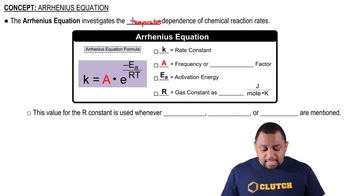
A reaction has a rate constant of 0.0117/s at 400.0 K and 0.689/s at 450.0 K. a. Determine the activation barrier for the reaction.
2476
views
8
rank
 Verified step by step guidance
 00:45
00:45
 01:20
01:20 02:10
02:10A reaction has a rate constant of 0.0117/s at 400.0 K and 0.689/s at 450.0 K. a. Determine the activation barrier for the reaction.
Which of these two reactions would you expect to have the smaller orientation factor? Explain. a. O(g) + N2(g) → NO( g) + N(g) b. NO(g) + Cl2(g) → NOCl( g) + Cl(g)
Consider these two gas-phase reactions: a. AA(g) + BB(g) → 2 AB(g) b. AB(g) + CD(g) → AC(g) + BD(g) If the reactions have identical activation barriers and are carried out under the same conditions, which one would you expect to have the faster rate?